


Ranger stopped so abruptly that the leash drew a red line across Maren’s palm.
She had been reaching for the infant room’s door, already thinking about the bottle warming at home and whether she had enough clean pajamas for the night. Behind her, paper mittens hung from clothespins along the hallway. Somewhere beyond the door, a music box recording was playing too slowly, its batteries nearly spent.
“What is it?” she murmured.
The German shepherd mix stood with his nose lifted, listening. Then he pushed past her legs.
Amy, the young attendant who had greeted them at the entrance, stepped aside with a startled laugh. “He’s eager today. Owen had a wonderful nap, by the way.”
Ranger crossed the room without looking at her. At the last crib on the right, he planted his feet and began to growl.
Maren had heard that sound only a handful of times. Never around Owen. Never in a room full of sleeping children.
“Take him out!” someone called from the changing station.
A chair scraped. Ranger struck the crib rail with one paw, then looked straight at Maren. His mouth closed. He lifted his paw again, directing it toward the small body beyond the bars.
Maren dropped the diaper bag.
“Show me, Ranger.”
He touched the rail at the level of Owen’s chest, turned toward her, and repeated the movement.
She knew that signal. Caleb had practiced it for months after the warehouse fire, back when a walk from the kitchen to the porch could leave him struggling for air.
Maren bent over the crib. Owen’s lashes lay against his cheeks, and the corner of his mouth had a color she could not accept until she touched him. His cheek was cool. Under his sleeper, his chest moved in small, inadequate pulls.
“Owen.”
No response.
Her old ambulance training returned in pieces so sharp they seemed separate from her terror: airway, breathing, color, responsiveness. She lifted him, supporting his head, and rubbed firmly along his back.
“Call an ambulance. Right now.”
Amy stared at the baby.
“Tell them an eight-month-old is barely breathing.”
A woman appeared in the doorway before anyone moved. Denise Kessler, the director of Taluna, wore a cream jacket that had never encountered finger paint. Her eyes went first to the dog.
“That animal has to leave.”
Maren was already dialing. “My son needs help.”
“You’re frightening the other children.”
“Then move the other children.”
Maren gave the dispatcher the daycare’s address in Darsen, Wisconsin, and described Owen’s condition. She kept her voice clear by looking at the little seam across his sleeve instead of his mouth. Ranger pressed against her calf, facing outward whenever a staff member approached too quickly.
Denise reached toward the leash.
“Don’t,” Maren said.
“We can’t have a dog behaving like this in an infant room.”
“He’s alerting. He’s trained to do that.”
“Whatever he’s trained to do, this is inappropriate.”
Maren turned her shoulder between Denise and the baby. On the phone, the dispatcher asked another question, and Maren answered it while counting Owen’s breaths.
Amy brought a chair. Maren did not sit. A second attendant began wheeling the other cribs toward the adjoining room, and their wheels rattled over the threshold. The music continued until somebody finally switched it off.
Without it, Maren could hear how little sound Owen was making.
She rubbed his foot through the sleeper. “Stay with me, sweetheart.”
Ranger whined once and looked up at her.
The first siren reached them before the ambulance came into view. Maren watched the entrance while Denise kept talking about liability, permission, the other parents. The words passed without meaning until two paramedics came through carrying equipment.
The man in front stopped when he recognized her.
“Maren?”
“Eddie. Please.”
He was beside her immediately. Years earlier, they had worked the same shifts, eating hurried meals beside the ambulance bay and finishing paperwork long after midnight. She had not seen him since before Owen was born.
“Tell me.”
“Eight months. No underlying conditions that I know of. Very slow breathing, poor color, difficult to wake. Ranger alerted when we came in.”
Eddie looked at Owen, not the dog. “Let’s have him here.”
Giving up the baby was harder than Maren expected. Her arms resisted even as she understood exactly why Eddie needed room. He laid Owen on the padded stretcher while his partner opened the pediatric kit.
The oxygen reading made Eddie’s expression change.
“We’re going now.”
An infant mask came out of its wrapper. Maren watched the clear plastic settle over Owen’s nose and mouth, watched the tubing straighten as the oxygen was connected.
Ranger stood close enough to see but did not interfere. When Eddie leaned over the stretcher, the dog backed away on his own.
Denise approached again. “Surely this could be a virus. He was sleeping normally when we checked him.”
Maren looked at her then. “He wasn’t sleeping normally when I got here.”
“We followed his usual schedule.”
“Bring the schedule to the hospital.”
Eddie’s partner glanced toward the doorway. “We need a place for the dog.”
“He comes with us,” Maren said.
The young man hesitated, one hand on the equipment bag. Maren knew the space inside an ambulance, knew every loose object had consequences. She also knew what would happen if Ranger saw Owen disappear behind those doors.
“He can ride secured in the front,” Eddie said. “We’ll make it work.”
Maren caught his eye. “Thank you.”
“Stay with your boy.”
Outside, the air had the dry, biting cold of a northern winter. Ranger followed the stretcher all the way to the ambulance. Only after Owen was inside did he allow Eddie’s partner, Nolan, to guide him toward the front seat.
Denise stood on the sidewalk with her arms folded over her immaculate jacket.
“Maren, we should discuss what happened before you make accusations.”
The ambulance door closed between them.
Maren sat beside the stretcher and took Owen’s hand. His fingers rested without their usual grip around hers. Eddie adjusted the mask, checked his breathing again, and spoke into the radio.
She understood the numbers he reported. That made it worse.
At a turn, Owen’s head shifted against the support, and Maren leaned forward instinctively.
“I’ve got him,” Eddie said.
“I know.” Her voice was barely audible. “I know you do.”
A low whine came from the cab. Ranger could not see the baby now, and every few moments Maren heard his collar move as he changed position.
“He’s still sitting,” Nolan called back. “Just worried.”
So was she. But worry was too ordinary a word for the sight of oxygen moving through tubing meant for her son.
At the hospital, the stretcher’s wheels struck the metal edge of the automatic doors. Warm air washed over Maren’s cold face. Eddie delivered his report while a doctor in blue scrubs walked backward ahead of them, asking questions.
“Any fever? Vomiting? Recent injury?”
“No. Nothing.”
The doctor glanced at Ranger when Nolan brought him through.
“He alerts to breathing changes,” Maren said before she could ask. “He found Owen like this.”
“I’m Dr. Imani. Keep him against that wall, away from the equipment.”
Maren shortened the leash. Ranger went where she directed, though his head remained turned toward the bed.
The room filled with purposeful movement. A nurse cut open a small packet. Another attached leads to Owen’s chest. Someone asked Maren about medications, allergies, his last bottle, the last time she had seen him fully awake.
She answered everything she could.
Her hands had begun shaking. She hid them beneath her elbows until Dr. Imani asked her to sign a form, and then the pen clicked against the clipboard.
Ranger rose from his place against the wall.
“Stay,” Maren whispered.
He lifted a paw and gave a short, insistent sound.
A nurse looked from him to Owen. The baby’s breathing had become uneven again. Seconds later, a monitor alarm sounded.
Dr. Imani moved closer to the bed. “We need more support. Get respiratory in here.”
Maren stepped back until her shoulders touched the wall. The team helped Owen breathe, adjusted his treatment, checked his pressure. Ranger watched from beside her, trembling through his flanks but keeping still.
Eventually, the numbers began to improve.
Dr. Imani examined Owen again before turning to Maren. “He’s responding. We’re watching him closely.”
Maren nodded because she could not manage anything else.
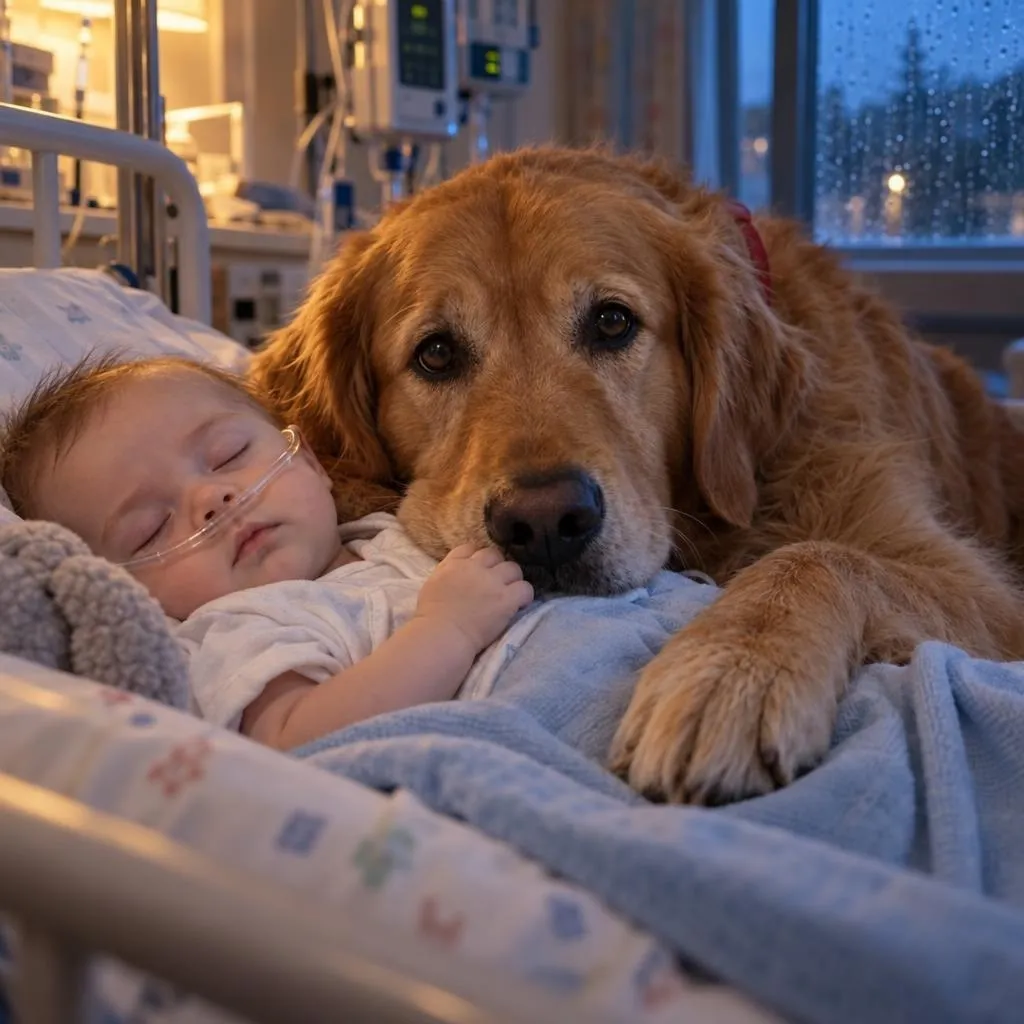
The hour that followed passed in small tasks. More questions. More blood drawn. A warm blanket someone placed around her shoulders. She loosened the leash at last, and Ranger settled at the foot of Owen’s bed where she could keep one hand on his neck.
Footsteps gathered outside the room.
Maren looked up expecting another nurse. Instead, Denise entered with two police officers and a man wearing an animal-control badge.
She pointed past the bed.
“That’s the dog. He attacked a child at my facility…”
To read the rest of the story – CLICK the NEXT button 👇👇👇