


The sale barn’s loudspeaker crackled over a bid nobody in the back lot seemed to hear. Caleb Mercer rested his forearms on the rail and watched a chestnut gelding accept a scratch beneath his mane. The horse’s lower lip loosened. Then the handler turned him toward the gate.
The opening was barely wider than the man’s shoulders. The gelding stopped, lifted his head, and backed away until the lead stretched straight between them. Two buyers who had paused nearby went on to the next enclosure.
Caleb kept looking at the horse’s eyes. They had gone past the handler to the broad, empty corner of the pen. This was the third time he had seen it happen, though the man holding the rope kept studying the horse’s feet.
Eleven horses stood in that lot, each marked with blue livestock crayon. Dale Haskett, who ran the auction, had said a hauler would collect whatever was left on Monday. The load would be going north. Caleb understood the destination well enough.
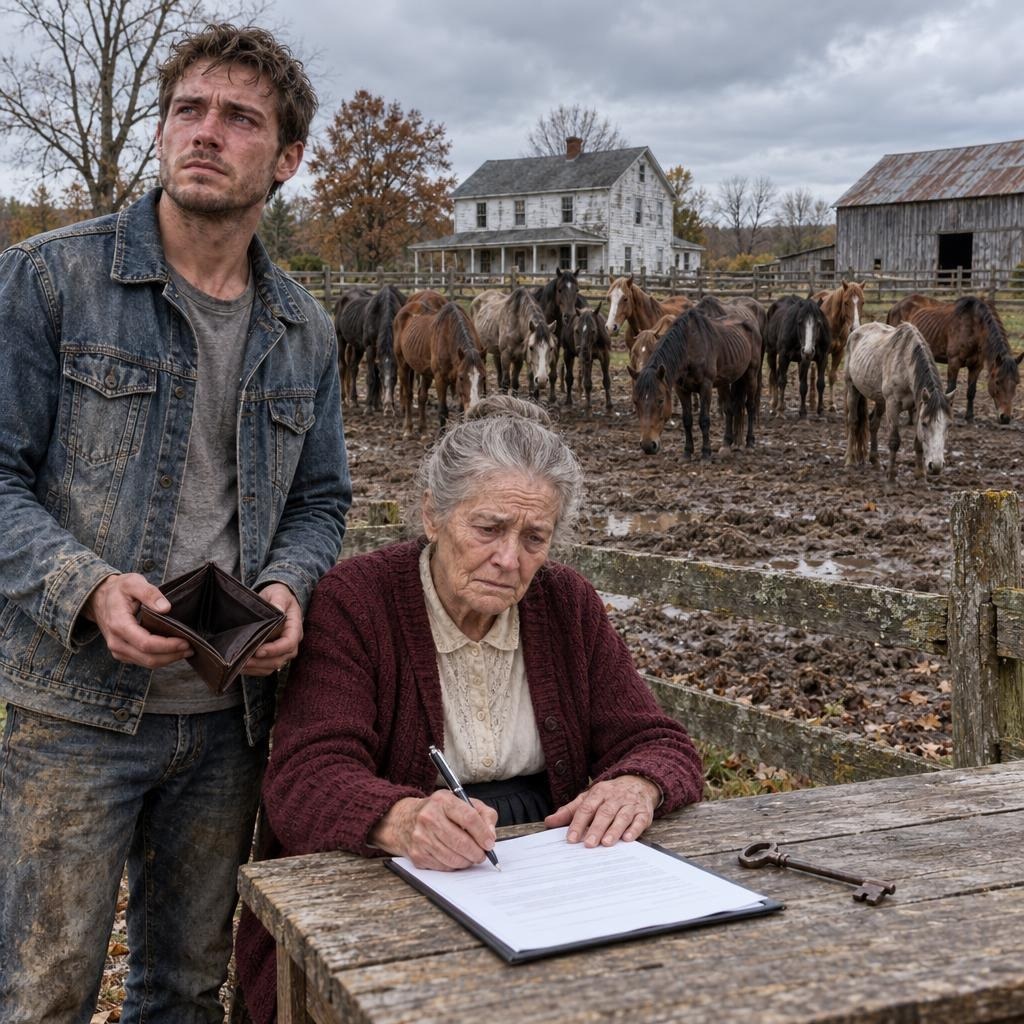
He had come on foot that September morning in 2010, following three miles of township road through the wooded hills of Vinton County, Ohio. His grandmother’s pickup was sitting at home with a bad fuel pump. In his inside pocket, an envelope had softened against his shirt. It held $3,060, accumulated over three summers of putting up fence, stacking bales, and pitching stalls.
He had meant to buy a truck with it.
A small bay mare rested one foreleg, then shifted off it again. An old scar drew her skin tight along the left shoulder. Nearby, a sorrel snatched his front foot away when a worker tried to examine it. The black mare scarcely moved until a loose strap touched her side; then a ripple ran the length of her belly. Two others needed flesh on their ribs before cold weather arrived.
Caleb walked the fence once more. At the far side, the chestnut put his nose through the rails toward him.
His grandfather would still have been there when the last buyer left. Walt Mercer had brought home horses called mean or useless and sometimes discovered a sharp tooth, a saddle that pinched, or a handler who wouldn’t wait. Other times he had found trouble he couldn’t mend. He never pretended otherwise.
Walt had died two winters before, while tending a gelding’s bruised hoof. Caleb remembered the folded towel beside his grandfather’s knee and the rasp still lying within reach.
Dale came around the corner carrying a clipboard. “You’ve made enough laps to wear a path. Looking for something?”
“All of them.”
The man glanced at the pen. “You’re not old enough to put your name on that sale.”
“My grandma is. I’d have to ask her.”
Dale rested the clipboard against the top rail and worked out a figure. Another buyer had already offered nearly that much for the whole group. He could sell them for $2,570, but he wouldn’t keep them past noon Monday.
On the walk home, Caleb subtracted the price again and again. Four hundred ninety dollars would remain. By the time he reached their lane, he had stopped trying to make that sound like enough.
Ruth Mercer was emptying diner tips from her apron pocket when he came into the kitchen. She had worked since before daylight. Caleb waited until she had separated the coins, then laid his envelope beside them.
She listened without interrupting. Afterward, she counted his money and reached for the account book she kept in a drawer beneath the telephone.
He knew most of what was in it. The county was waiting on overdue property taxes. His grandfather’s tractor had been idle since spring. A strip of barn roof leaked above the south stalls, and the hay from their own field wouldn’t come close to feeding eleven horses through winter. Six morning shifts a week at the diner paid for groceries, electricity, and the two people already living there.
“Amos might have extra hay,” Caleb said. “I could fence for him.”
“Amos Vail feeds stock of his own.”
“I haven’t asked yet.”
Ruth laid her apron across the back of a chair. “Before we ask anybody for anything, tell me what made you choose these particular horses.”
He started with the bay’s shoulder. Then the sorrel, the black mare, the gelding who would follow a hand across a pen but wouldn’t pass through a little gate.
Ruth asked what the shoulder would cost to treat. He didn’t know. She asked whether the sorrel could be made comfortable. He didn’t know that either.
“I’ll get people for them,” he said finally. “They won’t all stay here.”
“By what date?”
“Spring. I think most could go by spring.”
She left the account book open between them. There was plenty of time to change his answer. He sat with his hands beneath the table and let it stand.
Through the window he could see the barn, its doors shut against the afternoon glare. Ruth looked that way too. People in town still told Caleb how good his grandfather had been with horses. Ruth was the one who had waited for checks that came after the bills.
She called Amos first. Caleb listened while she asked about hauling, hay, and fence work. There was feed available on credit against his labor, though not enough to carry the whole winter. Then she called Dr. Vivian Shaw and arranged for the horses to be examined after they arrived.
Ruth wrote down both obligations.
“We review this in January,” she said. “School comes before barn work. Dr. Shaw decides when a horse is fit to work, not you. And if I say enough, your hands stop before your mouth starts.”
“Yes, ma’am.”
She closed the book over her pencil. “Spring isn’t a plan yet, Caleb.”
On Monday she signed the purchase papers. Amos hauled the horses in three loads, and Caleb rode along for each trip. By the last one, he could count the empty places at the auction without losing his breath.
Russell Danner stood beside the trailer while they loaded the final horses. Walt had occasionally worked at Russell’s stable, a place with an indoor arena, hired help, and customers who expected to ride on Saturday whether they had visited during the week or not.
Russell checked the safety chain and straightened. “Walt could earn his keep with a horse.” He looked into the trailer. “These eleven will eat whether you can or not.”
Caleb concentrated on coiling the spare lead. Russell waited a moment, then walked back to his pickup.
At home that evening, Caleb went from paddock to paddock with the feed cart. He had to stop and shake out his fingers before lifting the last bucket. From every direction came the steady sound of horses chewing.
He stayed outside after the buckets were empty. For almost two years, the barn had held little besides tools and the smell of old hay.
By breakfast, one water tub had tipped, a fence staple had pulled loose, and the little brown gelding was protecting a troublesome hoof. The bay’s stride lengthened after she had moved around awhile, but Caleb couldn’t tell how much the scar had to do with her stiffness.
The chestnut’s papers called him Jasper. He followed Caleb easily through the yard. At the stall entrance, he threw himself back so fast that the rope slid hot across Caleb’s palm.
Dr. Shaw made two visits during that first week. She treated the brown gelding’s foot and assessed the horses that needed weight, while Caleb wrote down feed amounts and questions. With the sorrel, she found reasons for further examination rather than a simple answer. Lifting his front foot bothered him, but she wasn’t yet certain where all the discomfort came from.
Three mornings after her second visit, Caleb tried to clean that foot before leaving for school. The sorrel leaned away. Caleb kept his grip. A hind hoof hit the stall wall, breaking a board, and the jagged edge opened the horse’s leg.
Ruth called the veterinarian again.
Caleb replaced the damaged plank while Dr. Shaw treated the cut. When he came inside, Ruth was entering the visit in her book with a green pen. He washed the sawdust from his hands, then went back out and stood beside the repair. The new lumber had no tooth marks, no rubbed places, none of the dark polish left by years of horses leaning against it.
With Jasper, he kept trying what Walt had shown him: ask lightly, then ease the lead when the horse stepped forward. In open ground, it worked. At a doorway, Caleb asked again, and Jasper backed again. Within two weeks, the gelding began walking away from his feed when Caleb appeared carrying a halter.
The school papers came home folded inside a textbook. An algebra sheet was unfinished; the history teacher’s note asked Ruth to contact him.
That night Ruth sent Caleb to the kitchen table and took the water buckets herself. He was still working when her boots sounded on the porch steps. It was fully dark, and her alarm would ring before sunrise.
During a dry spell in October, Caleb brought the black mare into the round pen. He had started calling her Tess. Dust clung to her coat where she had rolled, so he brushed her before laying a blanket across her back. She let him set the saddle in place and stood motionless while he checked it.
He drew the cinch up beneath her.
Tess reared and fell backward. Caleb lurched clear as the saddle horn gouged the dirt beside his leg. For a moment he could see nothing but hooves and the pale underside of her belly. Then she scrambled upright and stood trembling.
Ruth was at the gate by the time he loosened the saddle. She lifted it out of his hands and carried it beyond the fence. Tess took a few unsteady steps. Caleb stayed where he was.
His grandmother looked from the mare to him. “Was she shaking before you buckled it?”
To read the rest of the story – CLICK the NEXT button 👇👇👇