


The truck’s side mirror missed the lilac bush by inches. Raymond Booker waved both arms from beside the milk-house door, but the driver kept backing until the trailer stood squarely across the entrance to the old calving lot.
Raymond went to the cab. Through the open window he could see a paper coffee cup wedged against a dispatch tablet and a driver trying to straighten his back without leaving the seat.
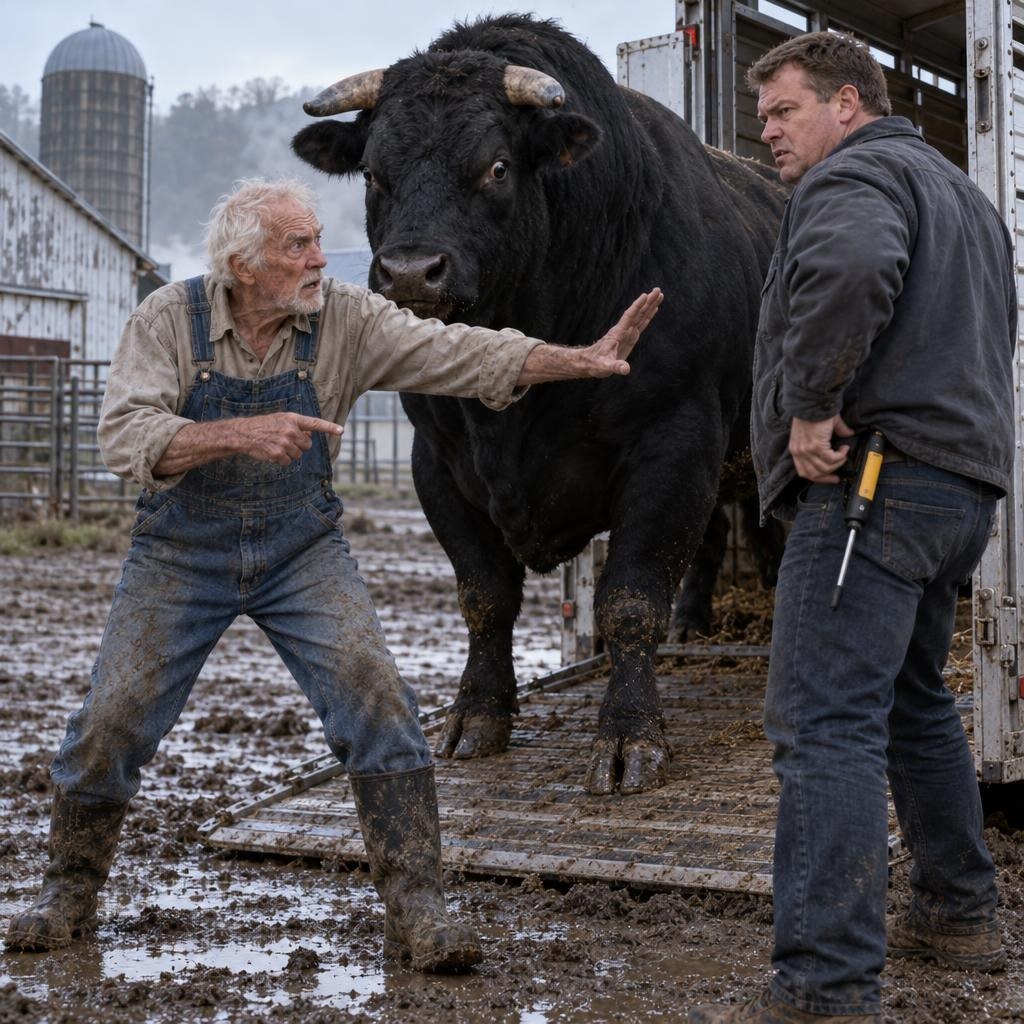
“You’ve come past your turn,” Raymond said.
The man held out a shipping sheet. “Lethren. That’s what your mailbox says.”
“Lethren dairy. You want the cattle company. Fourteen miles farther east.”
A blow sounded inside the trailer. The driver stopped moving.
Morning fog still filled the low pasture outside Dovren, North Carolina. Behind the trailer’s ventilation slots, something enormous shifted, gray hide showing briefly between dark bars. The lettering on the cab read VESKOR LIVESTOCK TRANSPORT.
“Curtis Vann,” the driver said, as though an introduction might improve things. “Their system gave me this address. I’ve been driving most of the night. Dispatch won’t pick up, I’m about out of hours, and those four heifers up front are supposed to reach Charlotte this morning.”
Raymond looked without touching the trailer. The animal in the rear compartment had the high shoulders and pendulous ears of a Brahman bull. His neck shaded almost black. A pale seam crossed his left flank; rubbed skin marked his nose. When Raymond moved, the bull turned his head until his right eye found him.
The left eye looked milky.
“Got a name?” Raymond asked.
Curtis ran a finger down the sheet. “Osvane Amos Six-Oh-Eight. They call him Amos.”
One ear stayed trained on Raymond. The other flicked toward a passing gravel truck.
At sixty-nine, Raymond had worked cattle under three different men’s ideas of how it should be done. His father had favored noise. The first herdsman who hired him had favored a long stick. June, his wife, could get a balky cow through a doorway by sending everybody else out of it.
“Has he had water?”
“Not since loading.”
Raymond glanced toward the abandoned calving lot. Concrete enclosed two sides; heavy pipe panels closed the front. June had insisted they stop using it seven years earlier, when a hinge began working loose from the masonry.
“He can rest there while you straighten this out,” Raymond said. “Not with my cows. And we brace it first.”
He called Ruth Keller next door. She arrived before he finished dragging the trough into place, two spare panels chained in her pickup. On her twenty-eight acres she boarded horses and took in the ones whose owners had run out of money or patience. Raymond had yet to name a piece of livestock equipment she couldn’t produce.
She studied the front of the lot.
“That panel’s already bent.”
“We’ll double it.”
“And that corner.” She pointed. “Brace that too, or we don’t unload.”
They chained her panels to the concrete posts, leaving a second barrier and an empty passage between Amos and the rest of the farm. Raymond shut his eighteen Jerseys in the upper lot. Bess, the oldest, objected from behind the barn door, where a late breakfast had become a personal grievance.
Curtis lowered the trailer ramp. Sunlight had begun breaking through the fog, and the ramp flashed silver. Amos crowded against the divider.
The driver struck the trailer with his palm. The bull threw up his head hard enough to rattle the fittings.
Curtis went to the cab and returned carrying an electric prod.
“Leave that in the truck.” Raymond’s voice carried across the yard.
“I’m not going to stand here all morning.”
Raymond pointed past him. “That loose plastic needs tying back, Ruth.” Then, to Curtis: “He can barely see out of one eye. Look at the shine on that ramp. He can’t tell where the footing ends.”
“You’ve had him five minutes.”
“And we’ve already scared him twice.”
Raymond fetched a forkful of old bedding and spread it across the metal from outside the bull’s path. Ruth fastened the flapping sheet against the barn. Bess bawled again, and Amos’s ears came forward.
Raymond opened an inner door. Through two separate rail partitions, the cow became visible in the dim barn.
Then they waited.
Curtis shifted his boots once. Ruth gave him a look, and he stopped. A little water dripped from a gutter onto an overturned pail.
Amos lowered his muzzle toward the covered ramp. Several minutes passed before he tested it with a hoof. He came down slowly, turning his clear eye toward Raymond and keeping away from the driver. On the gravel, the muscles above his knees trembled.
Raymond opened the prepared lane by reaching through from the service side. Amos found the trough without help. He drank for a long time, then lifted his dripping chin toward Bess.
Ruth spoke almost under her breath. “That’s the one they couldn’t load?”
“Let’s find out what else they know.”
Dispatch finally called while Raymond was reading a temporary-custody form against the feed-bin lid. Someone had attached the dairy’s address to the cattle company’s account. The intended buyer had expected Amos, but Curtis couldn’t legally make another livestock run. Dispatch was arranging relief for the heifers; another driver would retrieve the bull at eight the next morning.
“The owner’s got your number now,” Curtis said.
He paused before climbing into the cab. The prod lay on the floor inside.
“Six of us loaded him last night. Tore up a gate doing it.”
Raymond capped his pen. “Six men where?”
“All around him.” Curtis looked toward the quiet lot. “Yeah. I hear it now.”
After the rig left, Raymond put hay in the feeder from behind the barrier. Amos ate until Raymond walked toward his left shoulder. Then the bull swung around, leaving the hay to bring his right eye back onto the man.
Raymond tried once more from farther away. Amos turned again.
Ruth watched from the buffer passage. “Get Nora out here. Don’t make a diagnosis with a hay fork.”
Dr. Nora Finch promised to come after her morning herd visit. She also told him not to enter the enclosure, waited for his answer, and told him again.
He resented the repetition enough to know why she had done it.
The owner called shortly before eleven.
“Grant Sutter. Has anybody been injured?”
Raymond said no and described the water, hay, and double barrier.
“Good. Keep your distance. No treats through the fence, no walking in behind him. Quiet doesn’t mean you can trust him.”
Grant didn’t sound impatient. He sounded practiced.
Grant’s account began with a broken collarbone and a second man forced to scramble over a gate. At a collection facility, Amos had wrecked a crowding panel; three attempts to get him into breeding chutes had also failed. For six weeks, nobody at Osvane had worked him.
“The cattle company was giving him forty-eight hours,” Grant said. “Nothing transfers until they accept him.”
“To breed from?”
“They were going to assess their options.”
Raymond watched a fly crawl across the milk-room window. He knew the options for a registered bull nobody could handle.
“How old is he?”
“Seven.”
“And that eye?”
“He’s current on routine care. Our vet couldn’t finish a close examination after the last incident.” Grant paused. “I’ll cover reasonable expenses. You only have to hold him until morning.”
Outside, Amos had chosen a place near the barn partition. Bess was lying in straw beyond it. The bull stood several feet away, close enough to hear her shifting and chewing.
June had been dead twenty-two months. In that time Raymond had reduced the herd from thirty-four to eighteen and begun eating his supper beside the kitchen sink. There were still two places at the table. He dusted June’s chair but never pulled it out.
“What’s your price?” he asked.
Grant let out a short breath. “This isn’t an animal you buy because you feel sorry for him.”
“I asked the price.”
“Fifty-five hundred. Below what I have in him, above slaughter value. But your veterinarian has to approve the facilities, and every owner of the property signs the liability acknowledgment. I won’t put my name on anything less.”
Raymond looked toward the office doorway. In June’s filing cabinet was the will that had left their daughter one quarter of the farm.
Denise had wanted to discuss selling after the funeral. Seven months ago she had told him he was using the place to vanish while everybody could still see him. After that, he had let her calls go unanswered.
“My daughter owns part,” he said.
“Then she gets a say. You have until the truck goes.”
Raymond took his phone to the kitchen table. A photograph on the corkboard showed Denise at twelve holding a county-show ribbon upside down while June laughed beside her. He sat beneath it and pressed his daughter’s number.
She answered after several rings, cautious on the first word.
“Dad?”
“There’s a bull here. I need you to sign something so he doesn’t get sold for meat.”
“No…”
To read the rest of the story – CLICK the NEXT button 👇👇👇