


The hollow knock carried across the pasture before Nora Whitcomb saw which horse had made it.
She stopped beside the old dairy barn, her boots dark with melted frost. Six pale mares stood along its north wall. The oldest, identifiable by the scar across her left shoulder, had drawn back from the boards. Another mare stepped into her place and struck the wood once.
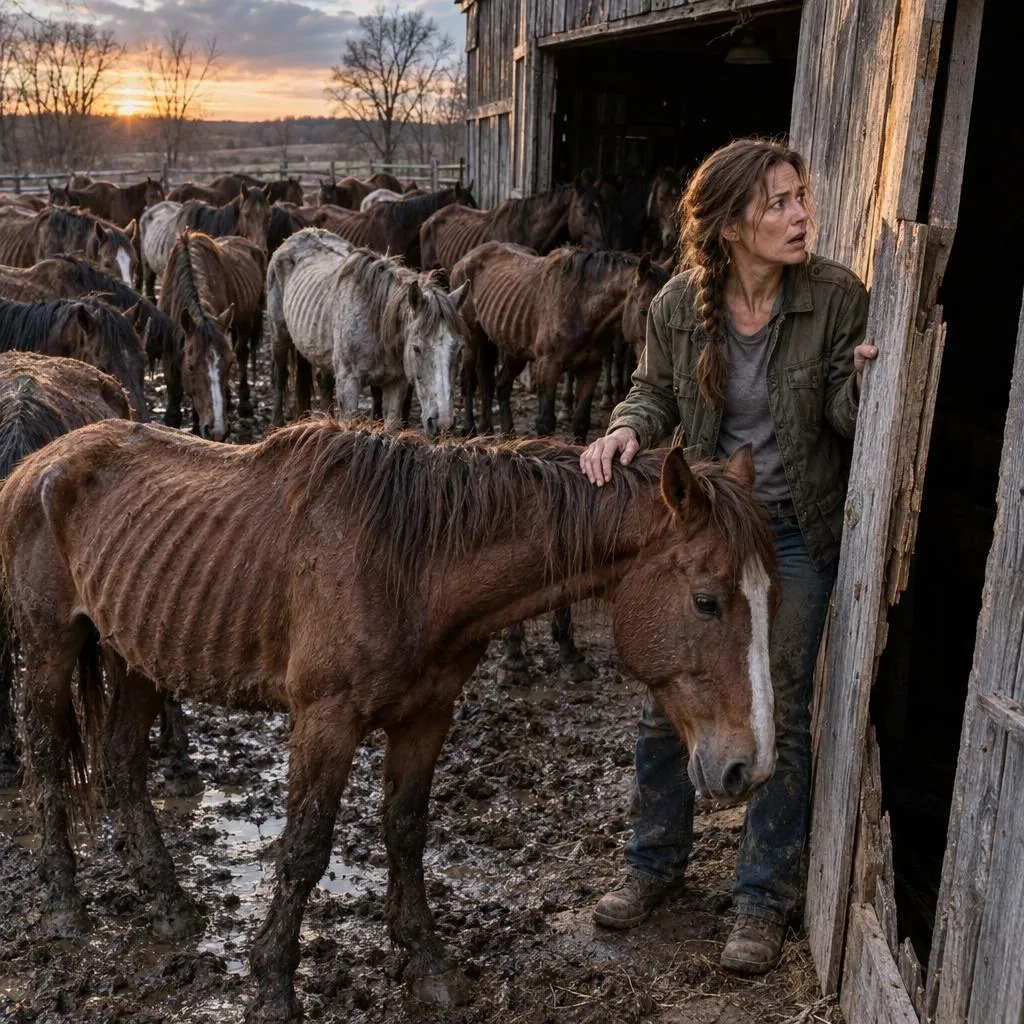
For four mornings, those six had abandoned the hay Nora put out and crossed close to half a mile of pasture to gather here. They didn’t linger under the apple trees or investigate the empty cattle shed. They came to this wall, where a room had been boarded shut since the early fifties.
On this fifth morning, Nora had followed without bringing a halter.
The scarred mare lowered her head to a gap near the foundation. Nora crouched beside her. One board had pulled away from its nail, leaving a narrow black space behind it. A little air came through, cool against her wrist.
She caught the edge with her fingers and pulled.
The wood moved.
A month earlier, Nora had sat in her pickup outside the farmhouse with a bank notice in her handbag and no idea how to get out of the driver’s seat.
The place outside Dunmere, Nebraska, had been hers since 1961. Before that, it had belonged to her father. He’d bought a hundred acres in 1928, added another hundred and sixty after the Depression, and raised oats, corn, milk cows, and heavy horses on it until his hands could no longer close properly around a fork handle.
By the time Nora inherited, most neighboring farmers had put engines where their teams used to stand. Her father’s dairy cattle were gone. The machinery he’d left her required repairs she usually couldn’t afford, and the north barn had become a building she drove past without looking inside.
She’d kept going for seven years by renting out a hundred and fifty acres for corn and soybeans and using the rest for a small cattle operation. It had never provided much room for error.
That year, rain kept the tenants out of their fields well into planting season. A summer windstorm peeled roofing off two equipment sheds. Then one tenant, whose crop had largely failed, couldn’t make his last rent payment.
The note Nora had renewed year after year came due anyway.
At the bank, the loan officer had laid the notice flat between them and kept his voice considerate. A substantial payment within forty-five days might let them extend the loan. Without it, they would have to begin proceedings that could put the farm on the market before winter.
The balance was $3,840. Her part-time wages at the county feed cooperative didn’t amount to that much in a year.
Nora had folded the paper along its existing creases. She hadn’t argued, or cried, or telephoned her sister. Now, home again, she watched a strip of loose roofing lift in the wind and settle back.
Nearly twenty minutes passed before she opened the truck door.
Her father had disliked a person getting loud with livestock. Whenever she’d tried to force a cow through a gate or hurry a balking team, he’d make her stand still first.
“Let the animal teach you something before you start correcting it.”
He’d said it about everything, right down to the hens. Nora used to roll her eyes when his back was turned.
The following day she went to the Averell County livestock auction with sixty-three dollars left after buying groceries and fuel. Two cheap feeder calves might give her something to sell in the spring. She knew that wasn’t much of a remedy for a debt due in weeks, but it was a purpose for the afternoon, and she needed one.
She was still there when the last lot came through.
Seventeen draft horses crowded into the ring. Their coats ranged from the color of skimmed milk to a deeper cream. Two were young stallions; the others were mares. Several wore hollows above their eyes and sharp ridges along their backs. One mare took short, careful steps as though she expected the floor to hurt her.
They’d been shipped from a farm in northern Kansas. That, and “draft type,” was nearly all the auctioneer had to tell anyone about them.
He asked a hundred dollars for the group.
A gate rattled somewhere behind Nora. Nobody bid.
At seventy-five dollars, the auctioneer waited a little longer. At fifty, he looked toward the livestock dealers along the back rail.
“You’d spend more hauling them,” a man called.
A few people laughed. Nora kept looking at the mare who was trying to favor her shoulder without losing her place among the others.
“Thirty-five takes the whole bunch. Anybody?”
Nora’s hand went up.
She lowered it almost at once, but the auctioneer had seen. He searched the benches for another bidder. Nora waited for someone to rescue her from what she’d just done.
The hammer struck.
At the desk, she counted out thirty-five dollars. Seventeen horses, and twenty-eight dollars left in her purse.
Clyde Renshaw stood nearby while the clerk pushed the receipt toward her. He’d traded livestock for more than thirty years and had never found much use for tact.
“You bought a load headed for the rendering plant,” he said. “You can’t afford this.”
Nora picked up the receipt.
“They’re alive.”
Clyde looked toward the unloading pens. “Ten dollars in feed for five dollars of horse.”
She folded the receipt smaller than it needed to be.
The arithmetic followed her home. So did the sight of that mare shifting her feet in the ring. Nora tried to imagine the horses filled out and sound enough to sell. Then she tried to imagine the hay they would eat before that happened.
By the time the last one stepped into her pasture, she couldn’t make either picture stay clear.
Dr. Victor Hensley arrived the next morning with his bag, a weight tape, and the expression he wore when a client had done something that would require patience from both of them.
He started with the stiff mare. Beneath an old, badly healed surface wound, her shoulder remained tender. Another horse had a cough that made him reach for his stethoscope. Four needed work on their teeth. Parasites were taking a share of what little nourishment the animals had received.
He worked down the line, checking mouths, listening to lungs, running his hands over ribs and legs. Most needed somewhere between a hundred and fifty and three hundred pounds. The youngest was barely two; the oldest mare looked close to twenty.
Yet he returned twice to examine their feet.
“Better than I expected,” he said, lifting one hoof again. “And these legs. Considering everything else, they’ve held up remarkably well.”
In the morning light, Nora could see how much the horses resembled one another. Pale manes lay against cream necks. Pink skin showed around their muzzles. Nearly every animal looked back at her with amber eyes.
“What kind did I bring home?” she asked.
Hensley set the hoof down carefully. “I need an answer to that myself.”
The sale documents offered no help. There were no pedigrees, no registration certificates, no breeding history. He turned the single thin sheet over, found nothing on the back, and handed it to her.
He believed most could recover. They would need measured feeding, treatment for parasites, minerals, dental care, and close watching. The oldest and the sickest would demand more of her than the others.
“How long?” Nora asked.
He rubbed a thumb along the edge of his weight tape before winding it up.
“Three months. Possibly four before they’re where I’d want them.”
Nora looked down at the figures he’d written beside each horse. Forty-four days remained on the bank notice…
To read the rest of the story – CLICK the NEXT button 👇👇👇