


The man at the console enlarged the image until the wreckage filled his screen. A woman lay against torn flotation material. An old German Shepherd covered most of her chest. Neither had moved during the last two passes.
Someone behind him opened a bottle.
“Close it out,” a voice said. “The water finishes this one.”
The satellite image disappeared beneath a mission-completion notice. In the sealed room, glasses touched.
Off the Washington coast, the dog raised his head.
Gavin Sloane saw the paw first.
It appeared beyond the helicopter’s open door, a pale patch against black rubber, then vanished when the swell carried the debris into a trough. He braced himself against the cabin frame and waited. Beneath the engines, the sea made a sound he could feel through the soles of his boots.
“Come left,” he told the pilot. “There’s something on that section.”
Lieutenant Erin Voss adjusted their heading without answering. She was thirty-one, small enough that her flight gear seemed built for someone else, with dark hair pinned beneath her helmet and eyes that seldom missed a gauge or a change in another person’s voice. She kept the names from their rescue board in a notebook. Gavin had never seen her throw one of those notebooks away.
The weak beacon had drawn them nearly thirty-six miles west of Tavren. A February gale had moved inland before sunrise, leaving broken water and ragged cloud over the coast. Somewhere behind them lay the naval repair yard, its cranes and brick shops tucked along a tidal channel. From here, land might have been an idea somebody had abandoned.
The debris rose again.
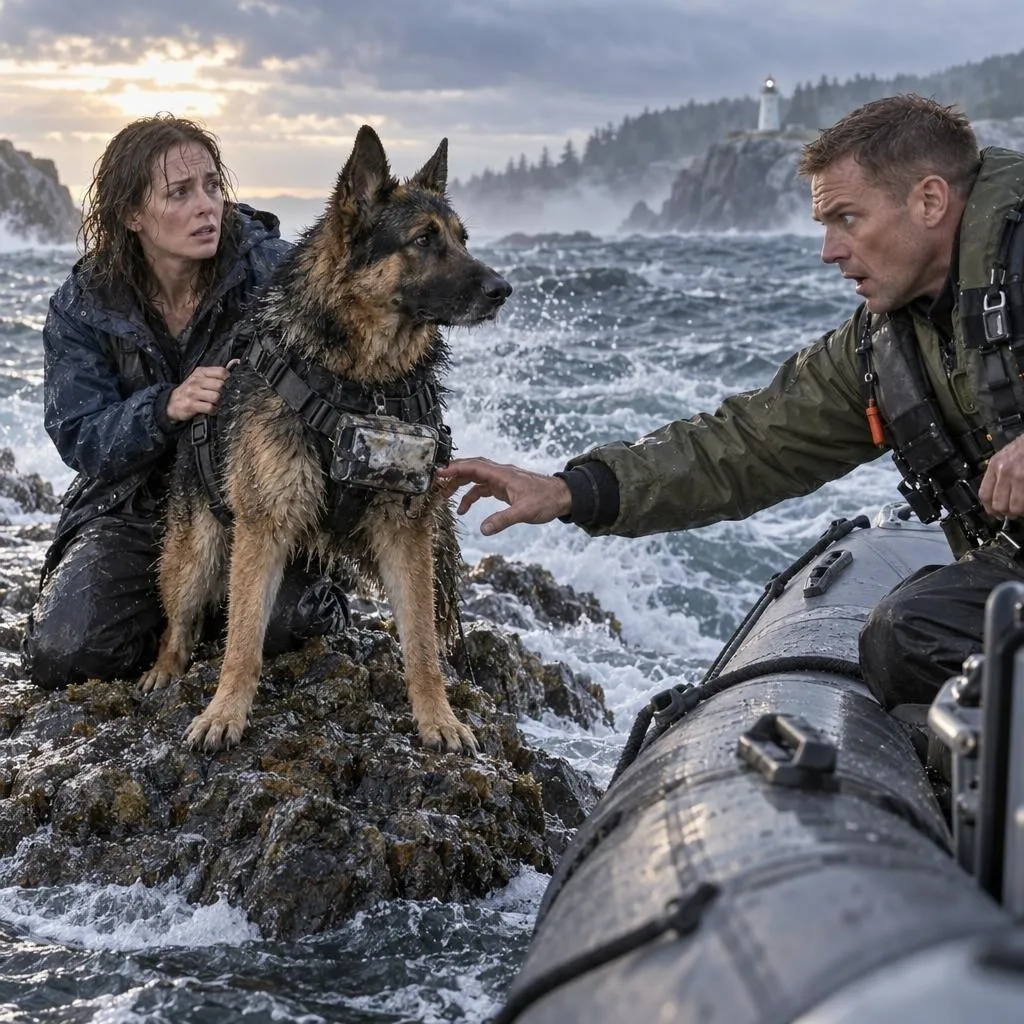
A woman lay on a torn section of inflatable rescue platform reinforced with a piece of fiberglass. One flotation chamber still held. The rest sagged under her body, its loose lines trailing into the water.
Across her was a black-and-tan German Shepherd.
“Two survivors,” said Derek Salazar from the hoist station.
“We don’t know that yet.” Gavin leaned farther out. “Bring us around, Erin.”
At forty-three, Gavin had spent enough years in naval special warfare to distrust the first hopeful interpretation of anything. Special recovery work had not improved that habit. There was gray above his ears now, and a narrow scar beneath his jaw that pulled when he clenched his teeth.
His sister Beth had died six years earlier while investigating fraud involving a defense contractor. Her death had produced a tidy official explanation and almost no useful answers. Ever since, Gavin found himself reading the bottom of a report before the top.
Below, the woman’s arm slipped from the platform.
The dog turned, caught her sleeve, and drew it back. His hindquarters shook as he settled over her again.
Derek stopped checking his harness.
“He’s keeping her on.”
Gavin nodded. “And he’s going to object to us.”
The woman wore a dark survival suit beneath a tactical flotation vest. One sleeve was torn, and a broad scrape marked the shoulder. Her cheek rested on the rubber. Wet brown hair had caught against her mouth, where no movement showed at this distance.
The dog’s head followed the helicopter. One ear stood; the other bent near the tip. Water streamed from an old tactical harness, its webbing polished by use. There was silver around his muzzle and a scar visible along his right flank.
Derek clipped into the lowering line. Twenty-eight, wiry, and usually ready with a remark, he had grown up in a working fishing town farther up the coast. His father had taught him to respect water without expecting kindness from it. On a rescue, Derek’s easy manner disappeared before his feet left the cabin.
Gavin caught his sleeve.
“Don’t crowd the dog. He’s trained.”
“I noticed the welcome committee.”
“Let him see your hands.”
Derek nodded and went down.
The first wave rolled over his shoulders before he surfaced. He turned toward the platform and worked across the swell. The shepherd struggled upright, legs spread for balance, placing his body between the swimmer and the woman.
Through his headset, Gavin heard the growl.
Derek stopped short of the wreckage.
Gavin switched on the external speaker. He lowered his voice, using the clipped delivery he remembered from handlers on deployments years before.
“Settle.”
The dog’s ears moved.
“Hold.”
For a moment, the animal looked directly toward the cabin. He remained standing, but his teeth disappeared beneath his lips.
Derek eased a hand over the platform’s edge. He reached the woman’s neck, waited, and looked up.
“Pulse. Very slow.”
Gavin let out the breath he had been holding.
“She’s badly cold,” Derek continued. “Hands are swollen. No obvious major bleeding. This suit’s the reason we have a patient.”
The woman’s right hand was clenched in the shepherd’s harness. Derek tried to work a sling beneath her shoulder. The dog snapped toward his wrist, stopping so precisely that the glove remained untouched.
“All right,” Derek said. “Message received.”
From above, Gavin noticed a flat, rectangular shape beneath the harness webbing. It was too carefully enclosed to be an ordinary pouch. Its seams had none of the exposed fittings he expected on rescue equipment.
“Leave everything on him,” he said.
“I’d like to leave my fingers on me, too.”
“Rig them together.”
Derek studied the damaged platform, the dog, and the woman’s locked hand.
“That’s going to be ugly.”
“Ugly is fine.”
Working around the shepherd’s watchful head, Derek arranged the rescue support so neither survivor would be lifted away from the other. Twice the platform rolled far enough to flood beneath his elbows. Twice the dog shifted to keep the woman from sliding.
Her lips moved when Derek tightened the last support.
He bent close.
“Briggs,” she breathed.
“The dog?”
Her eyelids fluttered. He got no further answer.
Derek signaled upward. “His name’s Briggs.”
The hoist took their weight. As the three rose, the empty platform tipped, filled, and folded beneath a wave.
Briggs kept one foreleg caught across the woman’s vest all the way to the aircraft.
Jonah Beckett helped draw them inside. The young petty officer had freckles, a narrow face, and an anxious habit of pressing his lips together before speaking. At twenty-four, he was good with an IV and much less comfortable when people noticed how frightened he was.
He reached for the harness buckle.
Gavin caught his hand.
“Work around it.”
“Sir, he could have injuries underneath.”
“Then check what you can. Nothing comes off.”
Jonah looked at Briggs’s lifted head and withdrew his fingers.
They covered the woman, secured oxygen, and began the measures they could manage in flight. Briggs collapsed across her lower legs, trembling so hard that the blanket over him quivered. His eyes remained open.
Erin turned them toward shore.
Gavin knelt beside the stretcher. Salt water ticked from the harness onto the cabin floor. The concealed rectangle had survived whatever had destroyed the boat, and the woman had refused to let go of it even as her body shut down.
He kept his own hands where Briggs could see them.
The repair yard’s landing pad appeared through low cloud, bordered by security vehicles and wet fencing. Beyond it, cranes stood above the tidal channel. The shops had been built to withstand heavy work and bad weather; even the windows looked difficult to break.
Dr. Ruth Mercer waited beside the medical team, her silver hair fastened at the back of her head. She was fifty-six, spare and tall, with a way of looking at an injured person that made everyone else remember what mattered.
“Exposure time?” she asked as the stretcher came down.
“Beacon history puts the vessel loss about thirty-one hours ago,” Gavin said. “She was partly out of the water.”
Ruth looked at the torn suit.
“Thirty-one hours,” she repeated. “Get her inside.”
She had spent two decades treating people who worked with ships: divers, welders, sailors, contractors who apologized for bleeding on her floor. Gavin had seen her reduce a crowded emergency room to useful silence with a single instruction.
Briggs came in wrapped in his own blanket. When the stretcher gained several feet on him, his growl brought the procession to a halt.
Gavin moved beside him.
“We’re going with her, Briggs.”
The dog watched his face, then limped forward.
In the secure clinic wing, snowmelt streaked the entry tile. Warm air carried the smell of antiseptic and old coffee. Ruth directed the rewarming without hurrying it, cutting away damaged outer material where necessary, arranging warmed fluids and oxygen, watching the monitors before permitting the next step.
The woman’s fingers slowly loosened from the harness.
“She had flotation, insulation, and that dog against her,” Ruth said. “Take away any one of them and we’d be doing something else.”
Briggs lowered himself beside the bed. His muzzle stayed aimed at the woman.
Laurel Finch arrived from the installation’s veterinary service carrying a treatment bag. Thirty-four, broad-faced, with short fair hair and sturdy hands, she had grown up on a dairy farm in Michigan. Gavin had once heard her explain that frightened animals were often easier patients than embarrassed men.
She knelt outside the dog’s reach and waited for him to sniff her hand.
“You’ve had a poor morning,” she said. “I’ll try not to make it worse.”
He let her examine his mouth, clean a cut on his front paw, and check the stiff hind leg. When she touched the edge of the harness, his lip rose.
Laurel stopped immediately.
“That part’s private, apparently.”
“Leave it,” Gavin said.
Ruth looked over from the monitor. “Wet webbing isn’t helping him recover.”
“I understand.”
“Then understand that there may be damage underneath it.”
Gavin’s answer came harder than he intended. “I said leave it.”
Ruth turned fully toward him. He rubbed a hand over his jaw.
“Until we know what it is,” he added. “Please.”
A civilian in a facility jacket appeared at the doorway with a tablet against his chest. His badge identified him as Simon Keene, technical support. He was young, neatly dressed, with expensive glasses and the uncertain posture of someone discovering that a room full of people could be harder to read than a screen.
“If that’s an altered locator,” he said, “equipment control needs to examine it. I can take it down.”
Briggs pushed himself upright. His back legs nearly failed, but he got between the man and the bed.
Simon stopped.
“I mean the equipment. Just the equipment.”
Gavin stepped across his path.
Behind him, the woman’s breathing changed.
Her eyes opened. Gray-green, reddened by salt, they moved from the stranger to the dog and then to Gavin. Her hand dragged across the blanket toward the harness.
Ruth bent over her. “Don’t try to sit up.”
The woman pulled at her oxygen mask.
Gavin leaned close enough to hear.
“Leave it on Briggs.”
“We haven’t removed anything.”
She caught his sleeve with fingers that barely closed.
“One wrong opening,” she whispered, “and they’ll know…”
To read the rest of the story – CLICK the NEXT button 👇👇👇