


The rifle came off its hooks with a small metallic click. On the other side of the door, whatever had been clawing at the boards went quiet.
I stood in my socks, listening. The kitchen clock showed a little past three. Then air pushed against the bottom of the door, a long animal breath, and the scratching resumed.
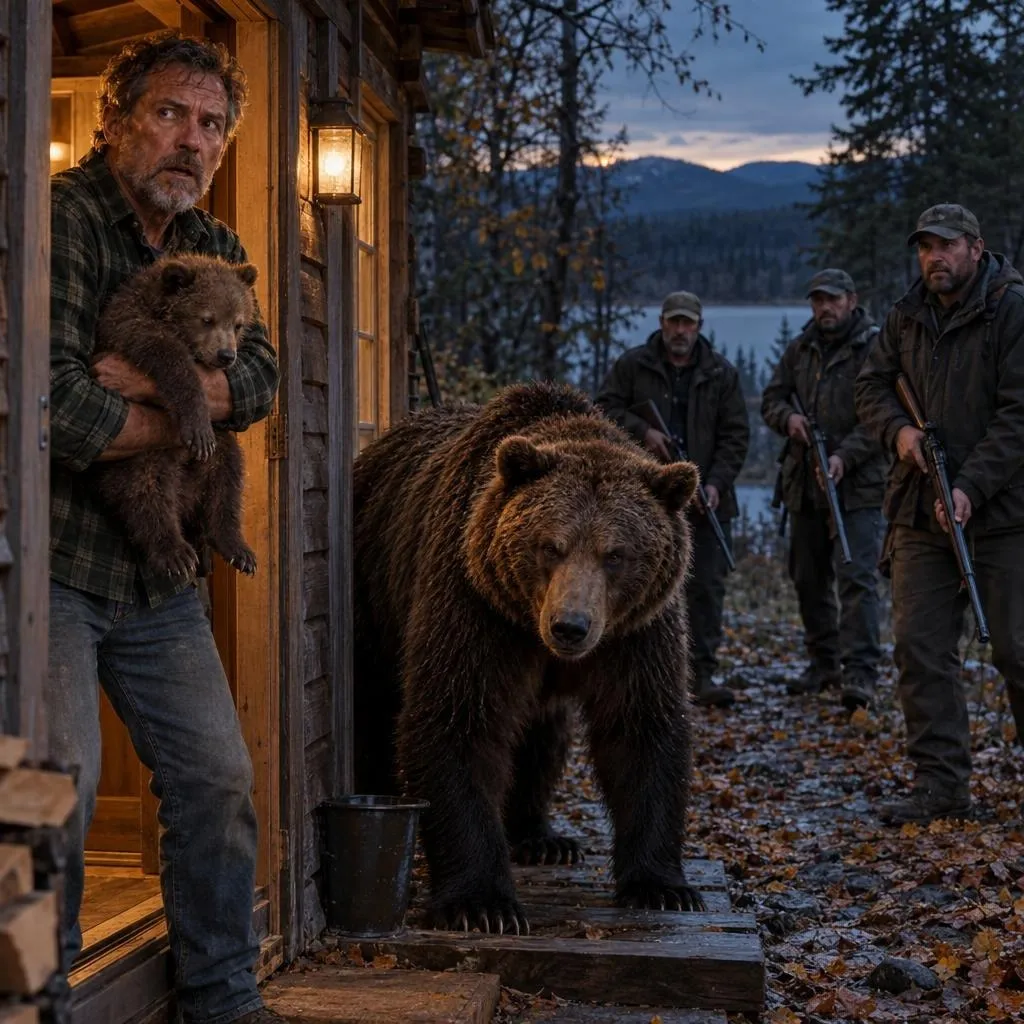
At the side window, I lifted the curtain with the rifle barrel. A black bear was retreating across the porch with a piece of coarse brown fabric clenched in her mouth. She released it near the sill, descended the steps, and stopped in the April snow.
The bundle moved.
I eased the door open far enough to see the clearing. The bear backed toward the timber. An old injury had left a light-colored slash over her nose, visible whenever she turned into the moonlight.
The thing on my porch gave a faint, broken cry.
It was a sack. Somebody had cinched the opening shut with cord, but the side had been torn apart. I hadn’t seen where the bear found it. All I knew was that she’d dragged it up the last stretch of porch.
I put the rifle down inside the cabin and crouched beside the bundle. A tiny black head lay against the ragged opening. When I peeled back the cloth, the cub tried to pull away, but his left rear leg stayed behind him.
I smelled the injury before I uncovered it fully. A steel trap could ruin an animal that way. I’d come across old ones in the woods, rusted but still capable of closing. This cub was scarcely bigger than a cat.
Snow crunched beyond the steps. His mother had advanced from the trees.
I held my hands still. She stopped too. For several breaths, neither of us moved, and the cold worked through the knees of my pajama pants.
“Let me see what I can do.”
She retreated beyond the reach of the porch light. I tucked the cub inside my coat, supporting the bad leg, and carried him to the kitchen.
His front claws scrabbled over the table until I slid a towel beneath him. They caught in the weave. He held on with such determination that I had to look away.
My daughter had once gripped my sleeve like that in a feed store. There’d been puppies for sale, a box of them beneath the counter, and Claire had been certain we needed one. I’d explained why we didn’t. I’d explained it again when she asked about a kitten, and later a hamster.
There was always some better time coming.
That spring I was fifty-one. My name is Nolan Keene, and I lived in the mountains above Darrow, in northern Idaho. Eight years earlier, a driver who’d been drinking crossed into my wife’s lane. Elaine and our twelve-year-old daughter never came home.
The cabin had been a place to stay during timber surveys. After the funerals, I stopped treating it as temporary. I went down for supplies, answered direct questions, and came back up. Sometimes I discovered at bedtime that I hadn’t spoken all day.
Now there was a living thing on my table, and I couldn’t keep my hands from shaking.
I built up the stove and brought out the first-aid supplies I kept for fieldwork. I could warm him, protect the injury, and clean around it. I couldn’t fix what had happened to that leg. When his head sagged and he quit resisting my hands, I stopped pretending the cabinet held what he needed.
My truck was stranded beyond a deep drift on the logging road. A telephone was no use up there. The nearest reliable radio belonged to Vernon Pike, a retired ranger who still occupied the old station, eight miles away by the winter trail. The station road was plowed.
From a peg by the door, I took my father’s quilted hunting coat. A spare button was still tucked into a pocket, wrapped in paper. He’d been dead for years, and I’d never found out what garment it belonged to.
I folded the coat into my pack, settled the cub in the warm hollow, and arranged the collar so his face stayed clear. Outside, the sow’s tracks angled toward the creek. I checked the cub once more before closing the door.
The trail required a different sort of walking with him on my back. I shortened my stride, tested crust before trusting it, and turned my whole body rather than twisting at the waist. Whenever I stopped, I reached behind me until I could feel him breathing.
At the creek, I swung the pack around to my chest. The footbridge was an old log with a rail along one edge. Meltwater crowded the banks below it, and ice made a slick lip along the unguarded side.
Halfway over, the cub complained.
“Stay with me, youngster. We’re getting there.”
I kept my eyes on the rail until my boots found earth again.
Vernon’s kitchen window was lit when I reached the station. There was gray daylight above the treetops. I knocked with the side of my fist because my fingers wouldn’t straighten.
He opened the door, looked at the pack I was holding against my chest, and moved his breakfast dishes off the table.
“Set it here.”
I laid the pack down and opened my father’s coat. Vernon removed his pipe and put it on a saucer.
“Where’d you find him?”
“On my porch. His mother brought him.”
That earned me a long look, but the leg ended the discussion. Vernon went to the radio.
He asked dispatch to find Rachel Dunn. Her father, Walter, had taught me how to work a stand of timber without getting somebody killed. Rachel had gone into veterinary medicine. I hadn’t seen her since we buried Walter four years before.
Her questions came through Vernon while I watched the towel beneath the cub’s chest rise and fall. She was nearly thirty miles away, but she could reach the station. She was loading her emergency equipment.
Vernon poured tea. I tried to wrap both hands around the mug and found my fingers clumsy against the handle.
“Worked with a man once,” he said, “who claimed a wolf brought him a hurt pup. Dragged it right up to his shack. Trap wound, same as this.”
“What happened to it?”
“Went back to its mother.” He nudged the mug toward me. “Have a swallow before you rattle that off the table.”
Rachel’s vehicle pulled up while the tea was still warm. She came in carrying two bags, her glasses misted and her hair coming out of its clip. She asked for a clear work surface and better light before she said much of anything to me.
After examining the cub, she rested her hands on either side of the towel.
“The infection’s serious, Nolan. It may already be affecting the rest of him.”
I looked at her bags. “Tell me what you need.”
“Right now, space to work. We’ll treat him. I don’t know yet whether it’ll be enough.”
Vernon fetched a lamp. Rachel started fluids, warmed the cub carefully, and kept checking him before she went farther. Once she was satisfied he could tolerate it, she gave medication for the examination and wound care.
I stood where she put me. Twice she had to repeat an instruction. Every pause in the cub’s movement seemed to shut out everything else in the room.
Rachel stopped and waited until I looked at her.
“Keep your eyes on his breathing. Leave the leg to me.”
I followed the shallow movement under his ribs. Beside me, Vernon held the lamp steady. His pipe lay untouched on the saucer, and outside a slide of snow thumped off the station roof.
When the wound was dressed, Rachel arranged the cub inside a padded carrier. She left its front open so we could watch him. His temperature still wasn’t where she wanted it, and she wouldn’t leave until she saw a response to treatment.
I sat down without remembering to pull out the chair.
Rachel brought the tea over and guided it into my hands. “Walter asked about you a lot. Especially after you moved up here.”
I studied a chip in the mug’s glaze. She didn’t fill the silence. Eventually I managed to drink.
The cub raised his head and made a demanding little noise. At almost the same moment, the kitchen dimmed.
His mother’s scarred face filled the window above the carrier…
To read the rest of the story – CLICK the NEXT button 👇👇👇