


Jonah could tell where the lion had been lying without looking up from the service path. Food disappeared from the feeding station. Water levels dropped. A shallow track led across the sand to the same ledge, day after day, and ended beneath the stone overhang.
For two years, that was nearly all Bram gave them.
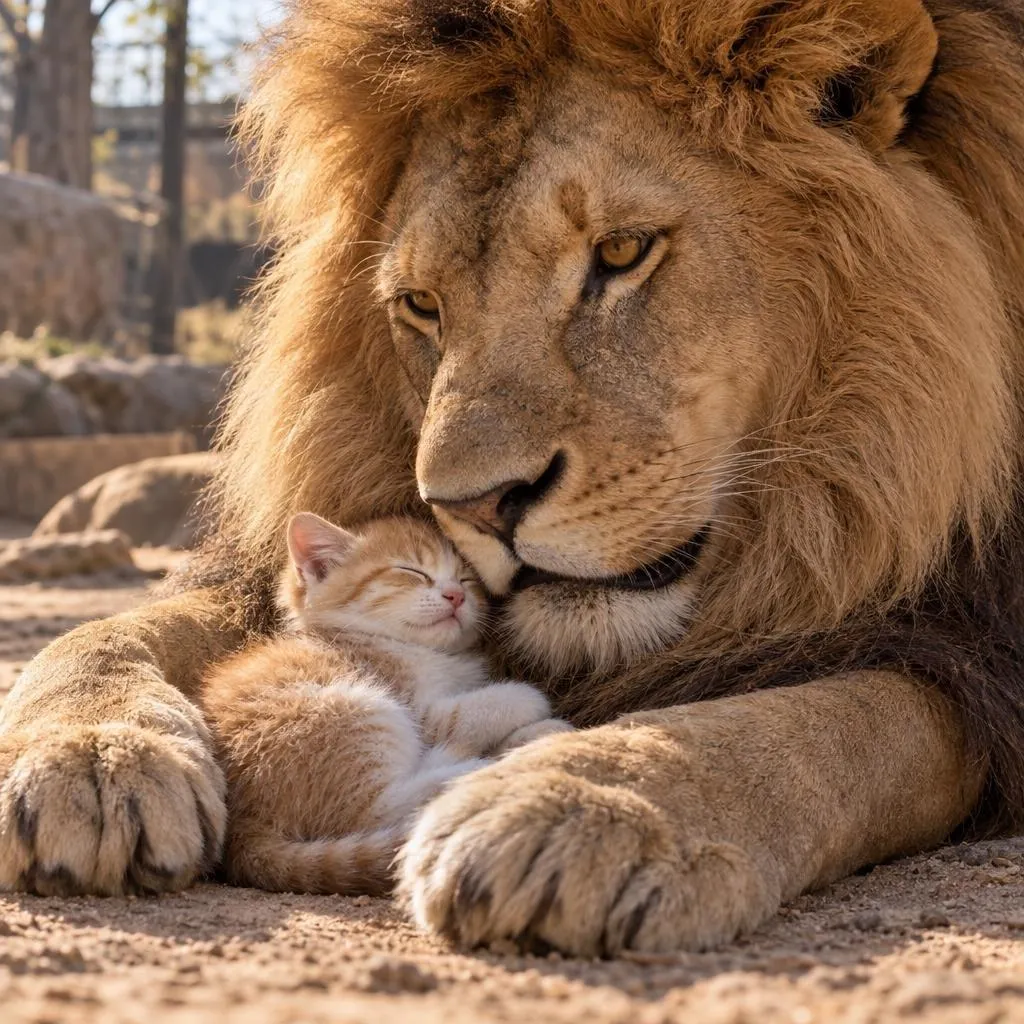
The morning he arrived at Talvessa wildlife refuge, his transport crate had rocked when he stood. He was a large male, even with his ribs showing beneath his coat, and the keepers had expected noise when the sliding door went up. There would usually be a warning, a protest, some rough announcement that the animal inside had reached the limit of what he could tolerate.
Bram stepped into the enclosure without making one.
He stopped with his head below his shoulders. His mane had been rubbed thin in places. Behind him, inside the empty crate, lay a few strands of fur and the stale smell of the private animal collection from which he had been confiscated. The cages there, outside a remote Utah town, had corroded around their locks. Feeding depended on whatever the owner could get cheaply.
The lion had survived it. That much was apparent. What remained of him was harder to assess.
Dr. Vivian Hale watched through the observation window while he crossed the unfamiliar ground. At every turn, his body seemed prepared for a blow that never came.
“Don’t push for a response,” she told the keepers. “He’s had a long time to learn that responding changes nothing.”
She believed the isolation had left him in a profound withdrawal. No pride, no ordinary exchanges with his own kind, no safe way to participate in the life around him. The veterinary examinations found problems they could treat. His silence offered no such clear course.
At first, everyone counted the days.
Jonah, a senior keeper, tried calling him while replacing the water. Other staff brought enrichment feeders and left scent trails through the habitat. From neighboring enclosures came the coughing calls of big cats, the sharp complaints of a lynx, an occasional coyote bark from farther down the grounds.
Bram’s ears scarcely moved.
He ate. Sometimes he walked the boundary. Mostly he settled on a broad shelf of sandstone in the southern habitat, where an overhang kept the sun off his face. He avoided the heated den built into the far wall, even in cold weather. The rock outside remained his place.
“Bram. Got something for you.” Jonah would wait at the protected feeding point, giving the lion time to look over.
The food would be taken later, when nobody was there.
Eventually, the dates in Hale’s records became months instead of days. Visiting specialists studied the footage and spoke carefully about how difficult it could be to reverse a withdrawal this deep. The keepers continued their work, but they stopped announcing every small movement as a possible beginning.
By his second summer at the refuge, Jonah knew the shape of Bram’s back from every camera angle. He had never heard his voice.
The kitten arrived during a hard turn in the weather near the end of August. Up on the high plateau, summer could still fill an afternoon with heat and leave frost in a bucket before morning.
Eli was opening the service entrance when he noticed that somebody had set a cardboard box against the outside gate. Its bottom had darkened where it touched the damp gravel. He checked the empty approach road, then bent to move it out of the way.
Something scraped against the cardboard from within.
He left the box where it was and reached for his radio.
“Could somebody from the clinic come to the entrance? I’ve got a live delivery, and I don’t think it came with paperwork.”
Dr. Lena Sorrell arrived with a towel over one arm. When she folded back the flaps, a white face looked up at her. The kitten’s eyes were a pale, watery blue. His whole body shook, but when she put a hand inside, he lifted his chin and watched her fingers.
Sorrell tucked him into the towel.
“Nothing with him?”
Eli turned the box over. No writing, no envelope, nothing caught beneath a flap.
“Just him.”
Inside the intake building, the kitten objected to having his temperature taken and tried to climb the sleeve of Sorrell’s coat. He was about three months old. Chilled, certainly, but in surprisingly good condition otherwise. She found no injury and no visible sign of parasites.
“You picked a poor morning to be outside,” she told him, rubbing him gently through the towel.
Jonah came in while she was settling the kitten into a fleece-lined carrier. A small white paw emerged through the door and hooked his finger.
“Well, there’s your problem,” Eli said from behind him. “Nobody told him he’s supposed to be scared of us.”
“He needs a substantial name,” Jonah said. “Something he can grow into.”
The kitten held on to his finger with determined little claws.
“Otto,” Jonah decided.
Sorrell tried it aloud. The kitten blinked up at her and gave a rusty squeak.
“Otto it is.”
They put him in a glass-fronted quarantine room with warm flooring, clean bedding, and a lamp over one corner. Once his shivering eased, he kneaded the fleece for several minutes and fell still. Sorrell left instructions for fluids and frequent temperature checks, then went back to the clinic.
For perhaps twenty minutes, Otto stayed where he had been placed.
What nobody noticed was the loose corner of a low ventilation cover. One screw was missing. The other held just firmly enough that the cover appeared secure until a determined kitten put his nose beneath it.
When Tess came to record his next set of observations, the bedding was empty.
She looked inside the carrier, under the chair, behind the small supply cabinet. Then she knelt and saw the tilted grate.
Her radio call brought Jonah at a run.
They opened access panels and checked the duct outlets. A kitten could fit into spaces a hand could barely reach, and the old intake wing had more of those spaces than anyone cared to admit. By midday, staff were searching beyond the building, peering under steps and into stacks of maintenance supplies.
Jonah carried a thermal camera. He scanned the shadow beneath a storage shed, changed the range, and scanned again.
“Come on, Otto,” he muttered. “You don’t know how much trouble you’re making.”
The little animal had been so cold when they found him. Every hour outside mattered. As afternoon light thinned along the canyon walls, Tess began searching places they had already checked, calling until her throat grew dry.
The temperature fell quickly once the sun slipped off the paths.
A voice came over the radio from the southern observation station, so hesitant at first that Jonah almost missed the words.
“There’s something white in Bram’s habitat.”
Jonah stopped beside the equipment shed.
“Where?”
“Under his ledge. You need to come look.”
Dr. Grant Bennett, the refuge director, answered before anyone else could. “Stay behind the rail. We’re coming.”
They reached the observation deck in a rush of boots and breath. Jonah went straight to the viewing glass, searching the sand for movement, for a place he could reach through a protected access hatch, for anything that would tell him they were not too late.
Bram lay beneath the overhang, forelegs extended. His mane spread around the lower part of his face, thick enough now to hide the scars along his neck.
Tucked against his chest, with one white paw laid over a fold of golden fur, Otto was asleep…
To read the rest of the story – CLICK the NEXT button 👇👇👇