


The trailer lurched hard enough to make the hitch clank. Isaiah Bell stepped away from the driver and looked through the slats again, rain running beneath the collar of his work jacket.
There was no palomino inside. A black horse was striking the partition with a front foot.
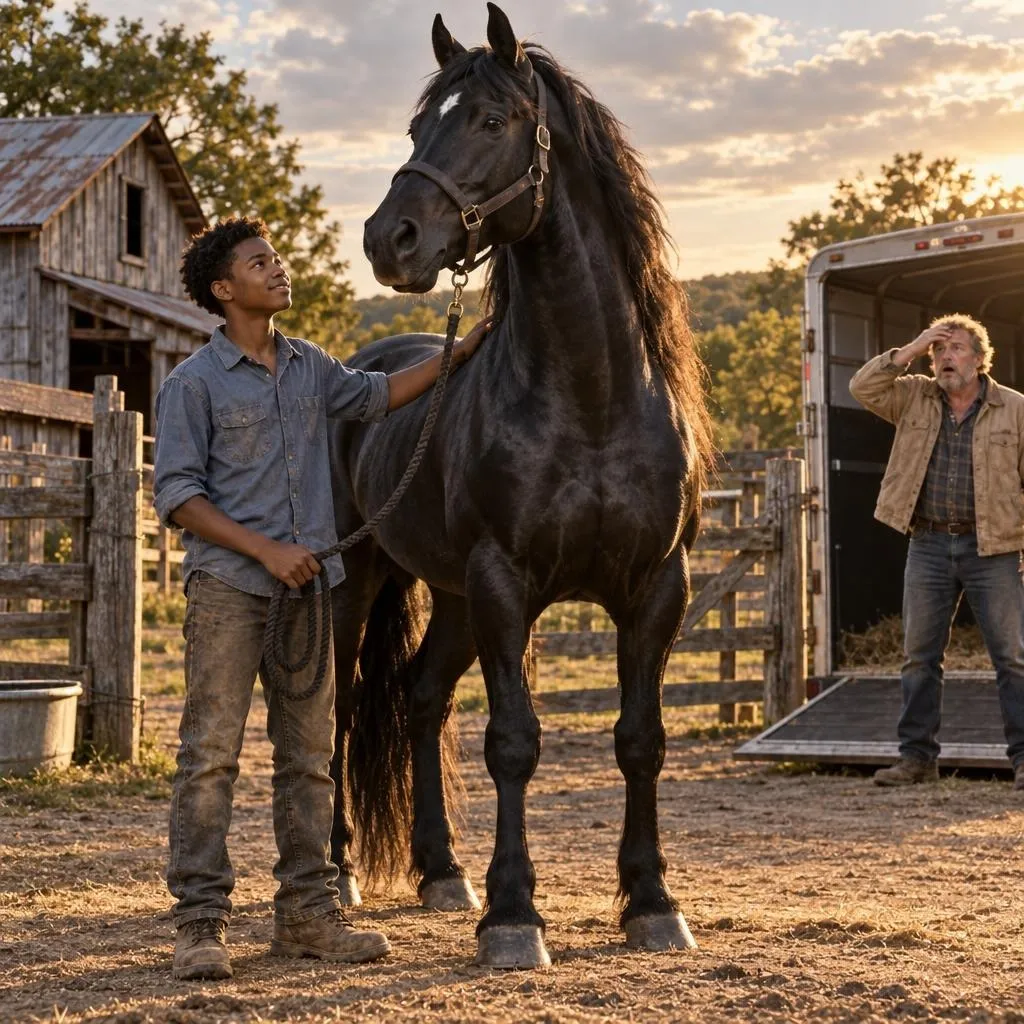
“Leave him loaded,” Isaiah said. “I bought Amber Banner. You need to call Mr. Voss.”
The driver was already working the latch. “I’ve got my instructions.”
Isaiah caught his sleeve. “Then get some different ones. That’s my family’s money.”
The man pulled free and lowered the ramp against the round pen. The horse came down sideways, all jutting bone and frantic muscle, dragging the man the last few feet. Once inside the rails, the driver got the rope loose, tossed it clear, and slipped through the gate.
“Sale’s final,” he said.
By the time Isaiah reached the driveway, the truck was throwing muddy water against the fence. Behind him, the stallion hit the round-pen rails with a sound Isaiah felt in his teeth.
He went back and secured the gate with a chain. The horse spun away, showing the whites of his eyes. Wet hair lay flat over a rack of ribs, and damaged places on his hind legs stood out beneath the mud.
Nine thousand dollars. Isaiah had spent nine thousand dollars on the horse that was supposed to keep the bank from taking their farm.
It was nearly dark before he got the stallion under a roof. He did it by dragging portable panels into place between the pen and the barn, then opening an empty stall at the far end. He filled the water tub first and cleared everything movable from the passage.
The halter the horse had scraped off lay beside the abandoned rope. Isaiah left both where they were.
For almost two hours, he shifted panels, waited, and backed away whenever the stallion stopped. Twice the horse rushed toward the barn and wheeled back. Finally, he found the open stall and lunged into its shelter.
Isaiah eased the lower door shut.
The click of the fastening sent the horse scrambling. A mare knocked her bucket across the aisle, and he flung up his head, catching the timber above him. Isaiah stopped breathing until the stallion found his feet again.
He put hay within reach, switched off the aisle lights, and left. There would be no going into that stall tonight.
His mother’s headlights crossed the kitchen wall a few minutes later. Valerie came in carrying her purse and the shoes she changed out of after work at the insurance office.
“Well?” she asked. “Did our new boy unload all right?”
Isaiah lowered his phone. Gordon Voss’s cheerful recorded voice was still talking.
“Mom, he sent a different horse.”
She set the shoes down without looking at them.
“The driver wouldn’t take him back. Voss won’t answer.”
Valerie reached for the phone herself. While it rang, Isaiah looked at the refrigerator. The bank notice was still held there by a magnet, the amount due marked with a red circle.
His father used to keep breeding records in that kitchen. Curtis Bell would sit with a cup of coffee gone cold, sorting the certificates for his five registered quarter horse mares, checking numbers against his notebook. He had built their place outside Lanton, in northeastern Oklahoma, while working other men’s fences and saving for his own.
“Know what you’re breeding,” he used to tell Isaiah. “A pretty horse won’t answer every question.”
Curtis had been dead three years. The loan Valerie had signed with him remained, along with leaning posts, a tractor that needed work, and a roof that leaked over two empty stalls.
Isaiah had finished high school that spring. He told people he was taking a year before community college, then went back to cutting hay, repairing fences, and helping unload feed before most customers reached the store. On nights he came home late, he sometimes found his mother doing figures by the small light over the stove.
The breeding plan had been his. Five mares, five foals, buyers among the cattle families who needed sensible working horses. If he could get a dependable stallion, they had a way to earn more than the farm cost them.
He had worked those figures until the paper softened at the folds. He had prayed over the decision. Then he had asked his mother to trust it.
Now she listened to the same voicemail greeting and pressed the button to end the call.
“Show me the advertisement again.”
He found it on his phone. Amber Banner stood in sunshine while a small girl ran a brush through his pale mane. The words beneath the photograph promised a sound, gentle, proven breeding horse.
Voss had sounded just as reassuring. His operation was two counties away, large enough that Isaiah knew the name before he called. The man had asked about the mares, called him son, and requested pictures of the farm. Isaiah had sent several, including one of himself beside Tilly, his father’s favorite mare.
Then another buyer had supposedly appeared. Voss had advised him not to wait.
The wire transfer went through the next morning.
Valerie took the phone when Isaiah opened the bill of sale. He watched her read more slowly toward the bottom.
“One stallion,” she said.
That was the whole description. No color, no breed, no Amber Banner. The registration space was empty. The remaining language made the purchase an as-is transaction, without guarantees, final upon delivery.
When Isaiah had asked about the missing number, Voss had told him the papers would follow the horse. He had made it sound so routine that Isaiah had felt foolish for asking.
Until then, the largest thing Isaiah had bought was his used truck.
“Maybe someone loaded the wrong trailer,” Valerie said at last. “A place that size, there could be a dozen people moving horses.”
Isaiah sent another text. They watched it remain unanswered.
The third morning, Dr. Arthur Lowell came up the drive with his veterinary kit on the seat beside him. He had treated horses around Lanton for more than thirty years, including every mare Curtis had owned. Since the funeral, he had never made a fuss about a bill arriving late.
He stopped well short of the stall.
“That’s a Thoroughbred,” he said. “No question.”
The horse walked a tight circuit, stopped, and walked it again. Lowell waited until he turned, then pointed out the damaged skin along the hind legs and the marks above the hooves.
“Restraints,” he said. “Too tight, and left on too long.”
He lifted a hand toward his cap. The stallion slammed away from him.
Lowell lowered his arm slowly.
“There’s been plenty done to this fellow.”
He watched another circuit. Under the poor condition, he could still see an athlete: room through the chest, strong joints, a long framework that starvation had made painfully plain.
“About sixteen-two,” he said. “He wasn’t always somebody’s wreck.”
The scanner took patience. Lowell stood beside the door while Isaiah kept clear, and neither man tried to force the horse closer. When the stallion finally extended his neck toward the hay, the vet passed the reader over him.
A beep sounded. The horse recoiled, but Lowell already had the number.
His office contacted the Thoroughbred registry. Within the hour, Isaiah was looking at a name on the veterinarian’s screen.
Cinder Oath.
He had raced when young, then passed through several owners. Gordon Voss had been the registered owner for the last two years.
Isaiah read that part twice.
Lowell packed away the scanner. “You need to understand the risk. A horse this frightened can hurt you before you have time to move. Professional help for one like him doesn’t come cheap.”
“I know.”
“Knowing and getting hurt are two different things. Stay out of there until we’ve got a safe way forward.”
Earl Dempsey arrived that Saturday with coffee in a dented thermos. He had lived next door for forty years and generally considered a closed mouth useful only while swallowing.
He stood at the barn entrance and looked down the aisle.
“So Voss finally got rid of his black stud.”
Isaiah turned toward him.
“Folks have talked about that horse at the sale barn for months,” Earl said. “Broke a handler’s collarbone last spring.”
They listened to the stallion pace.
“Let me take him to auction. Get what you can out of him before it’s your collarbone.”
Isaiah knew the buyers who stood around the pens for dangerous, thin horses. They weren’t shopping for something to put a saddle on. He looked at the scarred legs through the doorway and said he needed to make some calls first.
On Monday, a lawyer in the county seat explained the difference between having been cheated and being able to afford proving it. The vague description on the sale document would complicate the argument. A contested lawsuit could stretch beyond a year, and the retainer was money the Bells no longer had.
A small-claims case was possible. It would still take months to get heard, Voss would bring his signed agreement, and even a judgment wouldn’t put money in Isaiah’s hand that day.
Isaiah tried finding another buyer. He advertised the horse for less than it would cost to feed him through spring. One trader laughed as soon as he learned whose stallion it was. Another asked whether Isaiah could catch him.
“Not yet.”
The call ended a moment later.
Nobody else came to look.
Two weeks after the delivery, Isaiah found an envelope from Voss in the mailbox. He opened it standing beside the road, bracing the papers against his chest when the wind caught them.
Cinder Oath’s registration certificate was inside. Voss had completed the ownership transfer and signed it in blue ink.
Isaiah searched the envelope again. There was no explanation. Nothing about Amber Banner. No request to arrange an exchange.
He stood there until a passing truck forced him back from the gravel.
Voss had owned this horse for two years. He knew about the handler. He had written a sale document that promised no particular animal, instructed his driver, and prepared the transfer. Then he had mailed it to the buyer who kept calling.
The photographs came back to Isaiah: the patched barn, the old equipment, himself beside Tilly. An eighteen-year-old Black boy asking careful questions over the phone, with no experienced buyer standing behind him.
Voss had seen whom he was dealing with.
By the time Isaiah reached the house, his wet fingers had creased the envelope. Valerie read the certificate at the kitchen table and smoothed it flat.
“He meant it,” she said.
Isaiah nodded.
She folded her hands. “Then that money’s gone.”
Earl came over after supper. The next auction was on the twelfth, he said, and his trailer was available. He would do the hauling himself.
Isaiah stood at the sink, looking through the dark window toward the barn’s outside light. He remembered how the stallion had ducked from Lowell’s hand. He remembered the skin above the hooves.
There would be a check from the auction, but it wouldn’t restore their savings. It wouldn’t buy another stallion. It wouldn’t even buy them much time.
Behind him, his mother shifted her chair.
“Isaiah?”
He turned from the window.
“I’m keeping him…”
To read the rest of the story – CLICK the NEXT button 👇👇👇