


The clerk’s blotter was already soaked when Mabel Kessler realized she had pulled her purse against her chest. Across the table, the attorney still had his hand clenched beside the overturned water glass. He leaned across the low railing and pointed at the paper she hadn’t signed.
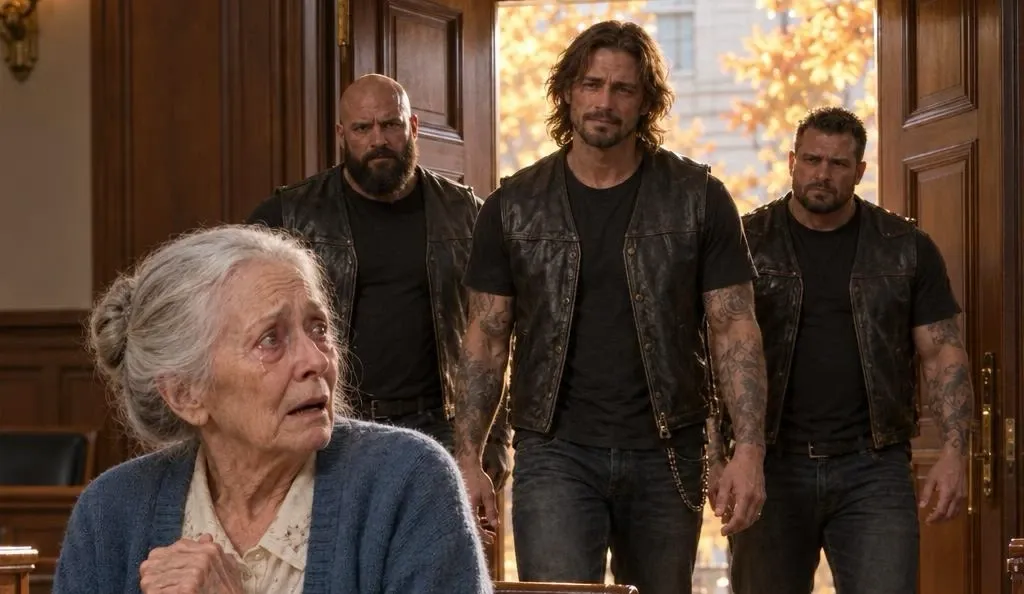
Mabel drew back. Behind her, the empty benches stretched all the way to the courtroom doors. She had never noticed how much room there could be behind one small chair.
The attorney straightened his cuffs. At the other table, his client watched her with a patient little smile.
Mabel lowered her eyes to the cracked handle of her purse.
At home, she could have repaired it. She knew what to do with things that came apart in her hands.
For fifty-one years, home had been a white frame house on Locust Street in Dunmere, Pennsylvania. The porch leaned toward the sidewalk, and the back room had a slightly different roofline because her husband had added it himself. She could still find his pencil measurements on the inside of the cupboard door.
The mill had ruined his breathing before it closed. By the time the machinery stopped, he was already gone.
Afterward, Mabel moved her sewing machine beside the back window. From there she could watch the light change on the fence while she shortened work trousers, replaced zippers, and made wedding gowns fit women who came to her apologizing for their bodies.
She kept a tin on the sill for payment. If someone stood too long with a wallet open, she would turn back to her machine and tell them to leave whatever they could.
She never checked the tin while they were there. Often she forgot to check it afterward.
A man whose coveralls she had repaired for most of her married life was buried in a shirt she had mended. A girl who arrived in tears the evening before her prom left with a dress that closed properly and no bill. Families brought funeral clothes wrapped in grocery sacks, and Mabel pressed them while somebody put the kettle on.
Dunmere had one traffic signal, a shuttered mill beside the river, and more houses than jobs. Almost everyone knew her back door.
She was fifty-four when a woman at church stopped her near the coat hooks and told her about the Mercer children.
Their parents had died when their car slid off an icy county road. There were three boys: Wade, twelve; Grant, nine; and Owen, who had just turned six. No relative had agreed to take them.
The county had found beds, but not in the same house. Each boy would be sent to a different town.
Wade had heard the plan three weeks earlier. He hadn’t spoken since. The reports described his silence in careful, concerned language.
Mabel asked where the boys were staying.
The caseworker came to Locust Street with a folder and a tired face. She looked at the narrow hallway, the two bedrooms, the sewing piled on a chair. Mabel had a little savings, no children of her own, and no experience with three grieving boys.
“You need to understand what you’re offering,” the woman said. “This won’t settle down just because they have beds. There’ll be behavior you won’t know how to handle.”
Mabel cleared a place on the kitchen table for the forms.
“I can explain the other arrangements,” the caseworker continued. “They would still have contact.”
“Mine. All three.”
Mabel put on her glasses and reached for the pen.
The first broken window came before the month was out.
Wade stood in the yard with a baseball at his feet, waiting for her to ask whether it had been an accident. She fetched a broom instead. He watched her fit a piece of cardboard over the opening, then went into the garage and stayed there until dark.
He ran away twice. The second time, rain worked through Mabel’s coat while she walked the county road calling for him. She found him on a guardrail near the place where his parents’ car had left the pavement.
He wouldn’t look at her.
She stopped a few feet away, breathing hard from the walk. Water dripped from the ends of his hair onto his jacket.
“I’ve got dry towels warming over the register,” she said.
For a long while, neither moved. Then Wade slid off the rail and walked beside her, far enough away that their sleeves didn’t touch.
Grant tried to hide the wet sheets. Mabel found them bundled beneath his bed one morning, and later found him standing rigidly beside the washer, waiting for what came next.
She handed him a clean pillowcase.
“Take that upstairs for me.”
He stayed where he was.
“Grant, honey. It’s laundry.”
That night, when she heard him crying for his mother, she sat outside the bedroom door until he let her come in.
Owen woke with screams that seemed too large for his little chest. Sometimes he fought the blankets. Sometimes he stared at Mabel as if she were another stranger who had come to move him somewhere else.
She learned to sit on the floor where he could see her. She told him about a foolish rooster she had known as a girl, and a neighbor’s mule that refused to cross a bridge, repeating the stories in the same order until his breathing slowed beneath her hand.
The sewing machine ran late in those months. Wade would come downstairs for water and find the lamp still on, Mabel bent over a seam with a cushion behind her back.
There were shoes to replace before the toes wore through and school lunches to pack. She wore the same two dresses, letting the hems down when the cloth at the folds grew thin.
When the weather turned cold again, she took her husband’s good watch into town. She came home without it and with three winter coats. The boys were told to try them on before supper.
Then Wade got into a fight at school.
He arrived with blood dried above one eye and his shoulders braced for an argument. Mabel pulled a chair to the kitchen sink, dampened a clean cloth, and began washing the cut.
At first he wouldn’t tell her what had happened. Then a few words came out, ugly words another boy had used about unwanted children and the people who took them in.
Mabel set down the cloth. She held Wade’s chin gently until he met her eyes.
“They lied about you, Wade. You’re my son.”
His mouth tightened. He tried once to pull away, then folded against her apron and cried so hard she had to brace one hand against the sink.
By the following spring, Owen had begun bringing things home.
Usually they were stones, bent nails, or feathers he insisted were worth keeping. One afternoon he and his brothers came around the house carrying a half-starved young mutt they had found behind the abandoned mill. One eye was gone, and old pellet scars marked the side of his face.
Owen named him Pellet before Mabel could object.
“We’re having enough trouble feeding the people in this house,” she said.
Wade looked down at the dog. Grant studied his shoes. Owen held the animal tighter.
Mabel went inside for a bowl.
Pellet ate in the kitchen with all three boys crouched around him. Afterward he limped past them and settled beneath Mabel’s sewing chair.
Nearly twenty years later, his muzzle would be white, his joints stiff, and that would still be his place.
The garage became the boys’ territory. During one long summer, Wade bought a motorcycle that didn’t run, took most of it apart, and discovered that confidence wasn’t a substitute for remembering where everything belonged.
Grant arranged the pieces on old towels. Owen crawled around the concrete looking for dropped nuts. For weeks, Mabel found oily fingerprints on the back door and heard arguments about parts she couldn’t identify.
When the engine finally caught, all three shouted loudly enough to bring her outside with her scissors still in her hand.
They grew tall and noisy. They could be difficult, stubborn boys, quick to take offense on somebody else’s behalf. Mabel didn’t ask them to become meek. But at the kitchen table, when a schoolyard fight or a neighborhood bully came up, she made her rule plain.
“Never start it. Never abandon somebody who needs you.”
Eventually, the work they needed lay beyond Dunmere. One after another, the brothers left on motorcycles with their belongings strapped behind them.
She never kept sewing through a Sunday call from her boys. They remembered her birthday with cards, and their Christmas gifts made her worry over how much they were doing without to send her that money.
She heard about repair shops, temporary jobs, bad weather, and long roads. In time, she learned that they had joined Ironwake, an outlaw motorcycle club whose patch made strangers give its members plenty of space.
Mabel still asked whether they were eating properly.
Then Dennis Rusk came to Dunmere.
He was a developer from Harrisburg, with a year’s worth of purchases already recorded around town. An interchange was being discussed beyond the old mill property. If it was built, the cheap blocks he was collecting would become very valuable.
He had bought from tired owners in other struggling towns. Some wanted to leave. Some needed cash. Others had simply grown weary of being asked.
By the time he knocked on Mabel’s door, he controlled nearly all her block.
She listened to his offer on the porch. He spoke about maintenance, taxes, and the burden of an aging house. She could sell while somebody was willing to pay, he explained, and spare herself a great deal of worry.
“My husband built that room,” she said, pointing toward the back of the house. “And I raised my boys here.”
“I understand the attachment.”
“Then you understand I’m staying.”
He left a card. She used it beneath a spool that kept rolling off her worktable.
The letter arrived on a Tuesday.
Mabel read the first page beside the kitchen window, then carried it to the table and started again. Pellet stirred beneath her chair when she said, “That can’t be right.”
A company she had never heard of claimed she had borrowed money against the property. There were references to a transfer, a default, and documents recorded with the county. According to the notice, she had thirty days to surrender possession. If she contested the demand, a hearing had already been scheduled.
She turned the pages, looking for an ordinary sentence that would explain the mistake.
The mortgage had been paid before her husband died, around the time the boys came to her. She remembered him burning the paid note in the kitchen sink while she laughed and warned him about the smoke alarm.
Her deed was upstairs, in a shoebox on the closet shelf.
She fetched it, spread everything beneath the light, and stayed there until the kettle boiled dry.
On their next Sunday call, she mentioned the letter to Grant. Before going back to the road, he had worked six years in a county office handling titles and property records, and she thought he might explain the language.
He asked her to read it aloud. Afterward he was quiet for several seconds.
“I’m going to look at something,” he said.
She told him not to make a fuss. Surely a local lawyer could straighten it out.
The lawyer she visited had known her for years. He took the shoebox from her, examined the deed, and read the copies filed by Rusk’s attorney.
Mabel waited with her gloves folded in her lap.
“These papers trouble me,” he said at last.
“Then you can tell the court they’re wrong.”
He shifted the documents into a neater pile. There were stamps, signatures, a notarized acknowledgment. Challenging them would mean obtaining records, gathering evidence, possibly hiring experts. His office would need money to begin.
She told him how much she had in the bank.
He took off his glasses.
“I wish I could promise you a result. I can’t. Even if we fought, you could lose.”
“But it’s my house.”
He looked toward the window before answering.
“If they offer a settlement, Mabel, you ought to consider it…”
To read the rest of the story – CLICK the NEXT button 👇👇👇