


The porch bulb was still burning when Odessa Bellamy opened the back door with a cup of birdseed balanced in her palm.
Sparrows quarreled beneath the eaves. She scattered seed along the sheltered side of the steps, where yesterday’s snow hadn’t crusted over, and told them they’d better settle their differences before the weather did it for them.
Inside, the kitchen smelled of wood smoke and the coffee she’d reheated twice. A photograph stood beside the stove: a young Black couple on their wedding day, Walter solemn in his borrowed suit, Odessa laughing at something outside the frame.
“You wouldn’t like that wind,” she told him. “Makes the whole house complain.”
She touched the picture of their son beside it, then reached past a folded bank notice for her gloves. The notice could stay where it was. She had an appointment to discuss it in person.
At the front door, her hand paused beside the porch-light switch.
She left it alone.
By the time she reached the bank, a fine snow was traveling sideways across Fellwick’s empty street. Winter had narrowed this corner of South Dakota to the places a person absolutely had to go.
Martin Kessler’s office was too warm. Odessa kept her coat on while she counted bills onto his desk, smoothing each one with a thumb.
“That’s what I’ve brought. Put it against the loan.”
He looked at the money without touching it. “Please have a seat.”
“I can hear bad news standing.”
“Odessa.”
She sat, lowering herself carefully. One knee had been disagreeable since November.
Kessler folded his hands. “You’re ninety days behind. We’ve reached the end of what the bank can allow.”
“And I’m asking you to reach a little farther. By spring, the survivor benefit from Isaiah’s service should finally be settled. I can catch up then.”
“We’ve discussed that application.”
“Discuss it with me one more time.”
He glanced through the glass wall toward the tellers. “There are changes coming out your way. Your property is valuable, particularly the acreage. A sale now could give you a fresh start in a smaller place.”
“Where, exactly, would I put forty-two years?”
“I’m talking about a practical decision.”
“So am I. Walter built those steps. My boy learned to walk on that porch. You’re talking about dirt. I’m talking about where I live.”
“The figures don’t support keeping it.”
Odessa rested her handbag on her lap. “Figures haven’t approved of much I’ve done. Somehow I’m still here.”
“That isn’t a repayment strategy.”
“No. It’s an answer to a man who keeps explaining my life like I haven’t been present for it.”
His mouth tightened. Behind him, a little clock made a dry clicking sound.
“How long?” she asked.
He lowered his eyes to the file. “Thirty days. Then the property goes to public auction.”
There it was, at last. A number she could use.
“I regret that,” he added.
“Then regret it while you put my money where it belongs.”
She pushed the bills toward him and stood before he could offer his hand.
Across the street, the diner windows were fogged almost to the lettering. Tessa Molina saw her coming and lifted a clean mug from beneath the counter.
“Your usual seat’s free.”
“Only coffee today, honey.”
A plate arrived with the coffee. Apple pie, the crust broken neatly at the point.
“Tessa.”
“It came out crooked. Can’t sell it.”
“That pie isn’t crooked.”
“Then I’ll have to speak to it.”
Odessa gave her a look. Tessa, who had a little girl to raise and a business that rarely gave her a full night’s sleep, met it without retreating.
“There’s also this.” She pulled a folded drawing from her apron. “Ruby made it for you.”
The animal had four purple legs, a long tail, and an expression of deep concern.
“Horse?” Odessa asked.
“That was my first guess. Then she said it barked.”
“Well, whatever profession it chooses, tell her I’m proud to own it.”
Tessa laughed and tucked a fork beside the plate.
The radio behind the grill interrupted a song with a weather bulletin. The coming system, the announcer said, could be the worst the area had seen in four decades. Anyone who didn’t have to travel should stay home.
Vivian Pruitt turned on her stool. “Someone saw motorcycles on the interstate. Men with those club patches.”
“In this?” Tessa looked toward the window.
“Exactly. What decent reason would men like that have for coming through here?”
“Maybe the same reason anybody comes through,” Odessa said. “They’re trying to get somewhere.”
Vivian lowered her voice, though nobody had difficulty hearing her. “You wouldn’t say that if they came up your walk after dark.”
“I’d ask whether they needed something.”
“And get yourself robbed.”
“Or meet somebody. Seems a shame to settle the matter before they knock.”
Tessa leaned on the counter. “Didn’t your mother used to feed people off the freight trains?”
“Two Depression winters. She’d hear a knock, put another cup of water in the soup, and get a bowl down. We ate every day, too.”
“You think things work out that way? Giving coming back to you?”
Odessa broke a piece of crust with her fork. “Wasn’t a trade she was making, honey. Neither am I.”
When she rose to go, Tessa offered to have Deputy Evan Mercer take her home.
“It’s a short walk.”
“It won’t feel short if that storm gets here early.”
“Then I’d best stop standing here arguing.”
She buttoned her coat and carried Ruby’s picture home inside it.
The snow thickened before she reached her gate. By late afternoon, the fields had disappeared. Wind drove little squeals through a gap beneath the kitchen window, and the stovepipe rattled whenever a gust struck from the north.
Odessa pinned the drawing beside Isaiah’s photograph. Then she checked the woodbox and set a pot closer to the heat.
“Your mother’s inside,” she told her son’s picture. “Quit worrying.”
Before bed, she stood by the front window. The porch bulb illuminated only a few feet of violently moving snow.
“Lord, get them under cover,” she whispered. “Whoever’s still traveling. Give them somewhere to go.”
Out on the county road, Ox had given his coat to Nolan and was beginning to regret pretending he didn’t need it.
The young man’s teeth struck together so hard he couldn’t finish a sentence. His gloves were wet through. When Rook took his wrist, Nolan didn’t seem to feel it.
“Keep looking at me,” Rook said. “We’re walking now.”
“I can’t get my hands to work.”
“They don’t have to walk. Your feet do.”
The motorcycles stood in a turnout behind them. Snow and moisture had stopped the engines; repeated attempts to restart them had exhausted what the batteries could give. The last open gas station had gone dark when the men approached its door.
Ox had watched someone inside turn the lock.
Three houses since then. Three unanswered knocks.
“They see the patch, that’s it,” he said. “Could be bleeding on their welcome mat.”
Nolan pulled the borrowed coat tighter. “We’re not asking to move in.”
“Save your breath,” Rook told him.
Ahead, something yellow held steady through the snow. Ox thought at first it was a vehicle, but the light didn’t move.
“A porch,” Rook said.
“Maybe nobody’s there.”
“Then we’ll find that out at the door.”
It took longer than Ox thought it should to reach the house. Nolan stumbled twice. At the steps, Rook put one arm around him while Ox struck the door with the side of his fist.
A lock moved.
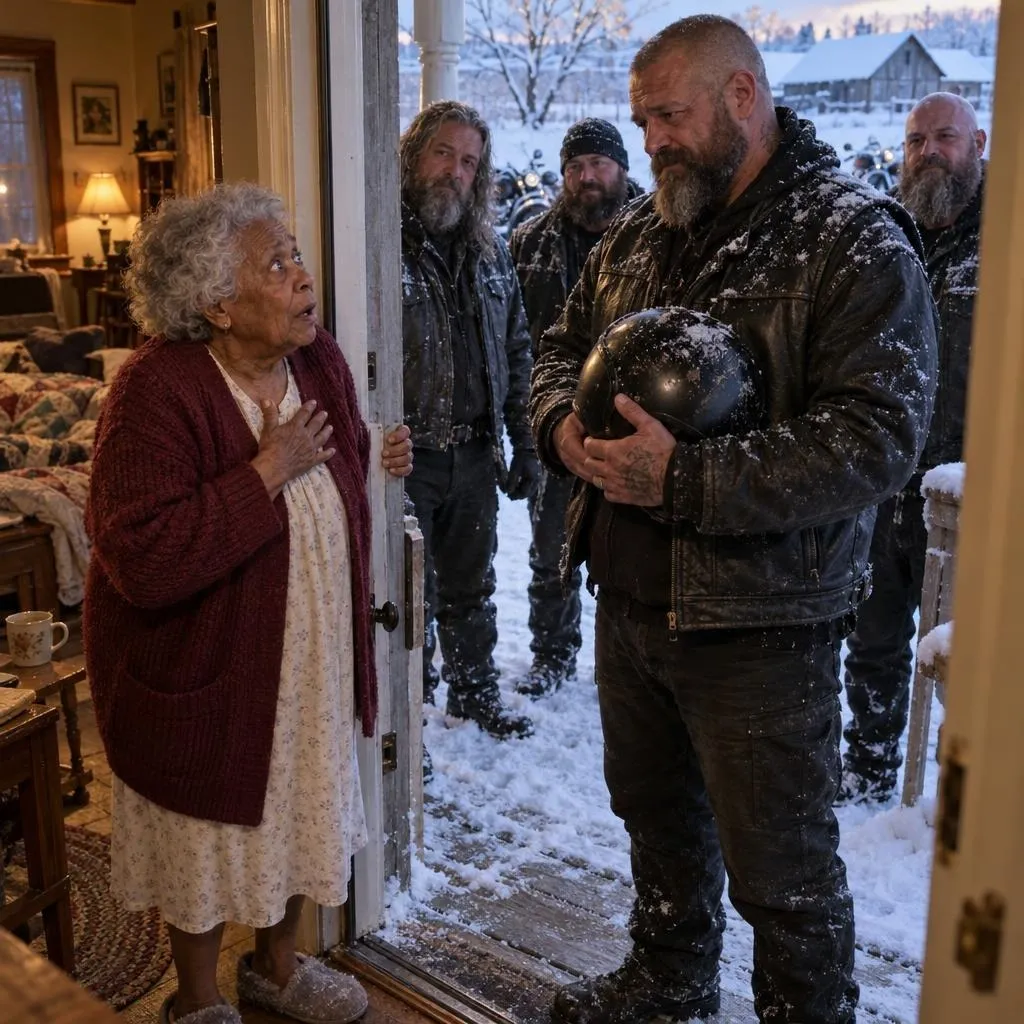
Odessa opened the door just far enough to brace it against the wind. Three men crowded the porch, one scarcely upright between the others. Ice hung in the beard of the largest one. The young man’s face had an awful empty color.
“Sorry to wake you, ma’am.” The man holding him spoke carefully. “We’ve walked a good mile, maybe more. He’s in trouble. We need somewhere to warm him.”
“How long’s he been like that?”
“Too long.”
The largest man glanced down at the patch on his vest. “Before you decide, you ought to know we’re—”
Odessa pulled the door wide.
“Bring him to the stove…”
To read the rest of the story – CLICK the NEXT button 👇👇👇