


Daniel Harlan was working a glove off with his teeth when Ruth Keene reached past the carnations for his usual flowers. The florist’s scissors made three brisk clicks. Then she stopped cutting and looked over his shoulder toward the window.
“Long stems?” she asked.
“Please.”
White chrysanthemums lay across the counter. Elise had preferred them because they held up long after other flowers began shedding on the kitchen table. Daniel could still see her tipping water into their chipped pitcher, pushing a strand of brown hair away from her mouth with her wrist.
He tucked his gloves into his police jacket. At thirty-five, he could still pass for younger when he was busy; standing still beneath the shop’s fluorescent lights, he looked like a man who hadn’t slept enough in several years. His afternoon shift left him time to cross the road, visit his wife’s grave, and get back to work.
Ruth’s scissors remained open in her hand.
“What’s out there?” he asked.
“Someone I was hoping you’d notice.”
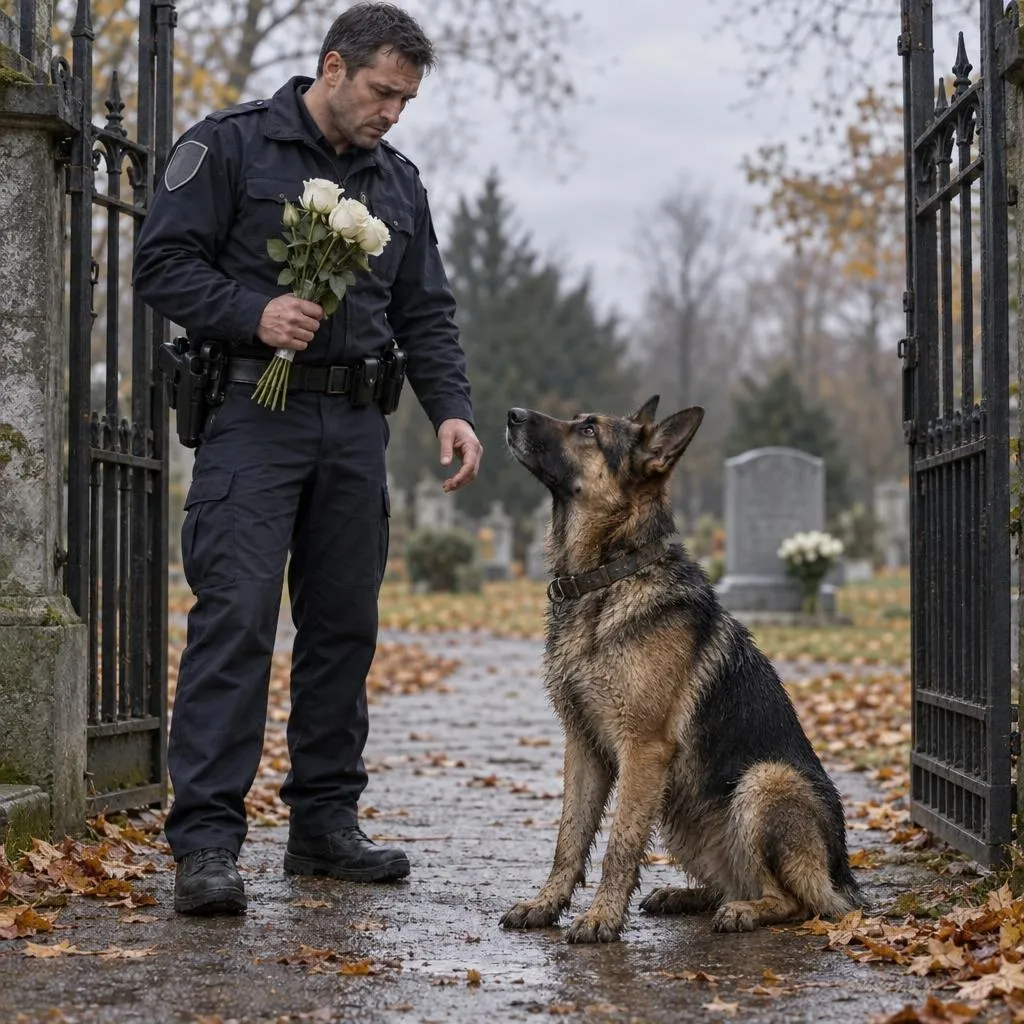
Across the street, beyond a scatter of wet leaves, an old German Shepherd lay beside the elm at the cemetery entrance. The tree’s roots sheltered part of his body. His face, pale around the mouth and eyes, pointed toward the road.
Daniel moved closer to the glass. A passing car made the dog lift his head. He watched it go, then put his chin down again.
“He’s been doing that a week,” Ruth said.
November had settled hard over Alderwick, Pennsylvania. The shop windows fogged along the bottom, and the water in the outdoor flower pails had begun freezing overnight. Daniel studied the shepherd’s narrow hips, the hind legs tucked at an uncomfortable angle.
“You’ve called somebody?”
“The rescue. They came once, but he backed right toward traffic. We agreed not to push him until they could try again.” She set the scissors down. “I take food over twice a day. Water, too. He waits for me to leave before he’ll touch either.”
Ruth was sixty-eight, with silver hair escaping the clip at her neck and a denim apron over a heavy sweater. She had run the flower shop long enough to know which customers needed conversation and which needed to be left alone. Today she kept rubbing a small crease out of the wrapping paper.
“I put a cushion beside him yesterday. He wouldn’t use it. He stays in that same little place, looking at the cars.”
Daniel watched the shepherd shift. The movement took effort: front paws braced, shoulders forward, a slow rearrangement of the back legs before he could lie comfortably again.
“Any tags?”
“I haven’t gotten close enough to see. There’s a collar.” Ruth glanced toward a monitor near the register. “At first I thought he’d slipped away from somebody. I kept expecting a person to come through the door asking about him.”
She called up a recording and moved aside.
The shop camera had caught the opposite curb beneath the streetlight. A small hatchback stopped. Someone in a hooded winter coat got out, opened a rear door, and waited while the shepherd climbed down. The figure looked middle-aged, though the picture wasn’t clear enough to be certain.
The person walked him to the tree. The dog’s tail stirred.
Then the figure returned to the car alone.
Daniel leaned toward the screen as the vehicle pulled away. The shepherd followed for a few steps, awkward and hopeful, until he reached the curb. He stopped there. Long after the car had left the picture, he was still facing the direction it had gone.
Ruth stopped the recording.
For a while, the refrigerator beneath the counter was the only thing Daniel could hear. Then a truck rattled past outside, and he looked through the window in time to see the dog raise his head again.
“Would you try?” Ruth asked. “Before you go in?”
He knew how to approach a frightened dog. He also knew what an eleven-year-old shepherd’s hips could mean, what an examination room smelled like after somebody laid a clean towel on the table and lowered their voice.
Three years earlier, illness had taken Elise at thirty-two. Later, his seven-year-old canine partner had died on a rescue assignment. Daniel had learned to keep going by staying occupied. He could answer calls, write reports, help strangers through the worst hour of their lives. At the end of a shift, there was nobody waiting for him to fail to save them.
Ruth folded the paper around the chrysanthemums without asking again.
He paid, thanked her, and went outside.
The wind worked through the opening above his maroon scarf. Across the road, the cemetery gates stood open, and the path to Elise’s grave curved uphill between stones Daniel recognized without reading. He knew what he would do there. Straighten the vase, replace the flowers, speak for a few minutes if words came.
The shepherd lay between him and the gate.
Daniel had almost passed when the dog looked up. No wagging tail, no attempt to solicit a hand. Just a pair of dark eyes following him with an attention too tired to ask for much.
A leaf had caught beneath the collar. Daniel noticed that first, then the broad forehead, then the way one forepaw rested over the other.
His partner used to wait like that outside the briefing room.
“Ranger,” he whispered.
He hadn’t meant to say it aloud.
The shepherd’s ears came forward. His gaze left the road and fixed on Daniel’s face. He pushed up through his front legs, trying to get his rear feet under him, and shook with the effort.
Daniel stopped moving.
“Easy. You don’t have to.”
The dog’s hind legs wouldn’t hold. He lowered himself against the roots, still watching.
Daniel placed the flowers on a bench and looked back at the shop. Ruth had come to the doorway, one hand keeping her sweater closed.
“Call them again,” he told her. “Tell them I’m going to sit with him.”
He lowered himself onto the cold ground well away from the tree, angled his shoulders aside, and let his hands rest open on his thighs. There had been a time when this kind of patience came naturally to him. He let the dog examine his stillness before he did anything else.
Then he removed his scarf.
He folded the wool near his knee, leaving one end stretched over the leaves. The shepherd watched every movement. When a car went by, his eyes followed it, but he turned back before the sound had faded.
Ruth brought a bowl of water. Daniel moved it within reach and withdrew his hand.
His phone vibrated. He took it out slowly, called the station, and arranged to miss the afternoon shift. The dog’s shoulders tightened at the sound of his voice, then eased when nothing else happened.
The cold had worked through Daniel’s trousers by the time the shepherd extended his neck toward the scarf. He sniffed, retreated a few inches, and tried once more. This time he moved a paw. His nose found the wool.
Daniel watched a person coming along the sidewalk and lifted one finger, asking for room. The person crossed farther down.
“There’s no hurry,” he told the dog.
The shepherd let his chin descend near the folded cloth.
Martin Bell arrived in a rescue van and spent a moment looking over the situation before he crossed the road. Forty-five, solidly built, with a close beard and brown hair going gray at the temples, he carried a blanket under one arm. His canvas coat had been repaired at one pocket.
“He’s been responding to you?” he asked quietly.
“A little. His back end’s weak.”
Martin crouched, leaving space between himself and the dog. “Keep doing what you’re doing. I’ll let him inspect the harness before we ask him to wear it.”
Nothing happened quickly. The shepherd smelled the straps, recoiled when one brushed his shoulder, and needed several minutes before Martin could try again. Daniel kept talking in the same low voice. He described the traffic, the cold, the florist who had been keeping him fed.
When the harness was finally secured, Martin spread the blanket. Daniel moved the scarf onto it. The old dog followed the cloth with his nose.
Together they supported him, stopping whenever his body went rigid. By the time they settled him into the padded transport crate, Daniel’s fingers were stiff and his knees ached.
He rode beside the secured crate while Martin drove. The shepherd stared out between the bars as the cemetery slipped away behind them. The scarf lay beneath his jaw.
At the veterinary clinic, Dr. Claire Bennett had a quiet room ready. She sat on a low stool rather than leaning over the dog immediately, letting him hear her voice while Daniel and Martin helped him onto the examination mat.
Claire was forty-six, tall and spare, with dark hair pinned away from her face and a pen tucked behind one ear. She asked Daniel to stay where the shepherd could see him.
“He keeps checking that you’re there,” she said.
She examined his teeth, listened to his heart and lungs, and worked carefully down his spine and legs. Daniel recognized the restraint in her hands when she reached the painful joints.
“About eleven would be my estimate,” she said. “He’s thin, worn out, and very sore. He needs a warm place, small meals on a schedule, and some help getting comfortable.”
She began treatment and wrote out a plan. Daniel read the feeding instructions while she explained the medication, then asked her to repeat one part. He didn’t want to remember it incorrectly.
Martin took a call in the hall and returned as Claire was arranging a follow-up visit.
“We’ll handle the identification search and the abandonment report,” he said. “He won’t be going back to that roadside. We also need to work out where he can stay.”
Daniel shifted toward the door to make room for a technician. The shepherd lifted his head at once.
He stopped with his hand against the doorframe.
“I could foster him,” Daniel said. “For now…”
To read the rest of the story – CLICK the NEXT button 👇👇👇