


Mara Ellery had a broken strand of wire caught in her pliers when the veterinarian called her name. She heard the change in his voice before she turned.
They had spent the morning getting escaped cattle away from the haul road along Veltrane’s eastern fence. Rain had worked through Mara’s gloves, and her socks had been wet since sunrise. She was thinking about the cash Dr. Everett Shaw would pay her for helping, and whether it would cover the next load of hay.
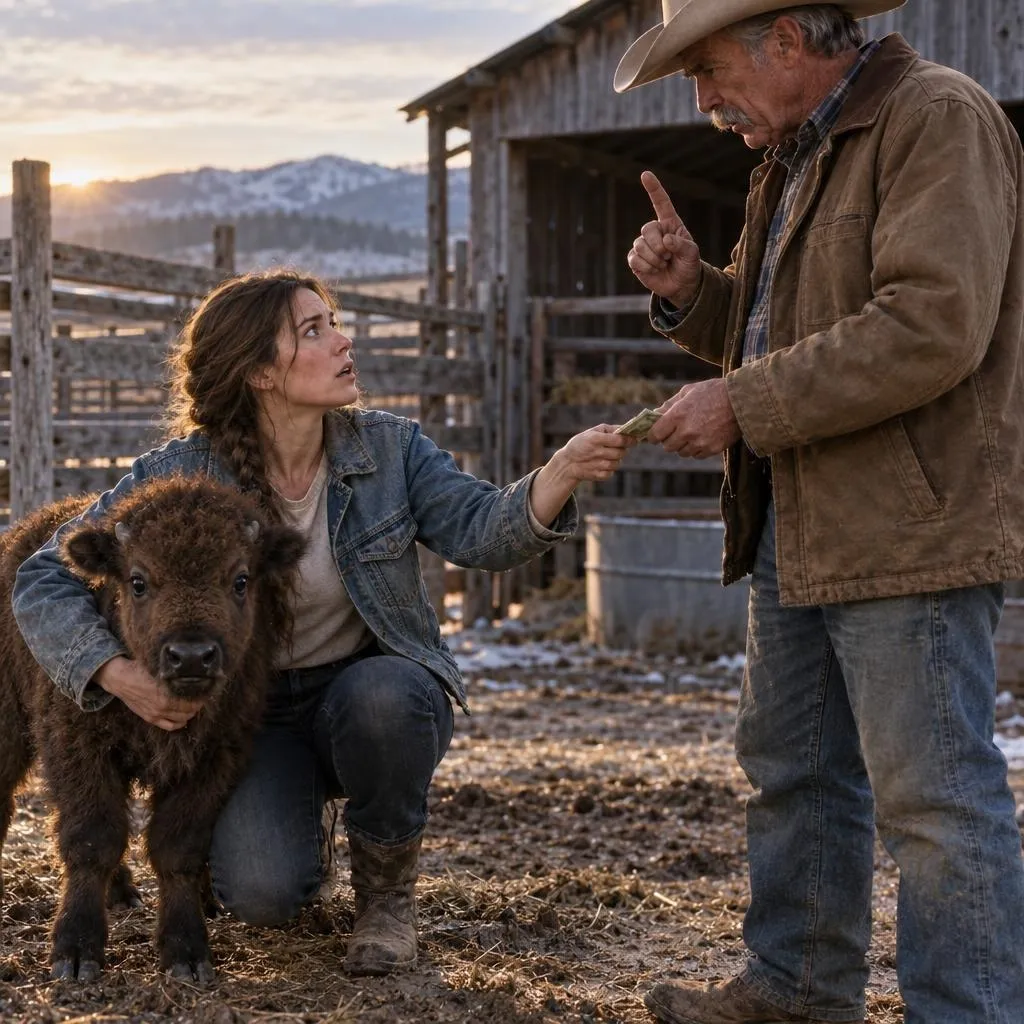
Everett was looking past her, toward a low patch of grass on the other side of the wire.
“Bring the truck closer,” he said. “Don’t crowd him.”
At first she saw only a brown shape pressed into the flattened grass. Then an ear moved. A young bison lifted his head and tried to rise, front legs trembling beneath him. His hindquarters never came off the ground.
The rest of the herd grazed some distance away. None turned toward him.
Mara climbed through the fence behind Everett. Mud sucked at her boots as she approached. She had seen thin stock before, but the hollows above this calf’s hips made her slow down. Rainwater ran along ribs she should not have been able to count.
Everett knelt beside him. He checked beneath the jaw, felt along the neck, then worked his fingers through the soaked hair over the calf’s back.
“Bull calf,” he said. “About five months. This didn’t happen over a bad weekend.”
“Where’s his mother?”
“That’s the question.” He glanced toward the herd. “Dead, sold, culled. Somewhere in that chain, somebody stopped looking for her calf.”
The animal moved one front hoof, trying again to arrange himself for standing. Mara watched him fail, rest, and begin the same small effort.
She was thirty-seven, with seventy-four acres paid for and whatever extra grazing she could afford to rent. She knew the cost of a bad animal. She also knew that Everett had not yet offered a hopeful word.
An employee named Kirk came down the road in a utility vehicle. He leaned across the fence to read the ear tag, checked it against something on his phone, then repeated the number over his radio.
“He was marked in September,” Kirk told them. “Off the active list. Somebody was meant to deal with him.”
Mara looked at the calf’s feet, still moving in the mud.
A dark pickup arrived before Everett had finished his examination. Russell Voss stepped out wearing a clean canvas coat and boots that had not yet touched the morning’s work. At fifty-two, he owned several thousand acres outside Darrow, and few herds in western North Dakota were larger than his.
He could make a buyer feel like the only person at a sale. Mara had also watched him forget a hired man’s name while the man was still holding a gate for him.
Russell stopped beside the calf. His inspection lasted less time than it took to pull his gloves on.
“That one was supposed to be culled.”
“He’s alive,” Everett said.
“For now.” Russell checked his phone. “There’s no place for him in the program.”
He spoke about feed days, labor, animals that fell behind the schedule. Mara understood every expense he named. Russell knew his business, and a commercial herd could not be managed one calf at a time.
Still, she asked, “What happens to him today?”
Russell put the phone away. “I’m not paying to haul that anywhere.”
The calf drew his front legs under him again.
“I’ll take him,” Mara said.
Kirk looked at her, then at his employer.
Russell’s eyes traveled to her pickup. It was twenty-one years old, with a repaired bed rail and a rear fender she had never bothered to straighten.
“You’ve priced bison fence lately?” he asked. “Or are we hoping cattle panels and good intentions will do it?”
“I said I’d take him. I didn’t ask you to keep him.”
He smiled pleasantly. “You can barely justify new posts on your own place. This animal eats money even when he’s healthy.”
Kirk gave a short laugh. Mara did not look at him.
“Get whatever paperwork you need,” she said. “He can have his chance at my place. Otherwise, you can finish what your crew forgot.”
Russell studied her a moment. Then he asked Kirk to fetch a transfer form.
Mara could almost see the calculation changing. A neglected calf beside a public road was a different problem from a calf that belonged to somebody else.
Russell filled out the form against the hood of his truck. He entered the tag number, described the animal, and wrote one dollar on the price line. Everett stood close enough to see him sign.
Mara searched her coat pocket and found a folded bill among a handful of loose staples. She passed him the dollar, took the pen, and signed beneath his name.
Russell tucked the money into his shirt pocket.
“The corner chute’s available,” he said. “Assuming you can get him there.”
“We’ll manage,” Everett said.
Russell walked back to his truck. Before getting in, he turned toward Mara.
“Real stockmen cut their losses. You’ve got a year to learn.”
She bent to help Everett spread a tarp beside the calf.
They never used the loading chute. With the trailer backed as close as they could safely bring it, they eased the animal onto the tarp and moved him together. Mara lifted under the hips. She had braced for more resistance than his body offered.
Inside the trailer, out of the rain, Everett examined him again. His flashlight picked out the joints as he worked down each leg. He lingered over the knees and hips, then sat back against the partition.
“What?” Mara asked.
“Big skeleton for what’s on it.” He reached forward once more, measuring the width across the hips with his hands. “Long lower legs. Substantial joints. I wouldn’t have expected that.”
“Does it help?”
“I don’t know yet.”
He would not promise her anything. She appreciated that, though she wished he had.
At home, Mara worked beneath her truck lights, repairing the holding corral before they unloaded. Everett helped settle the calf and left instructions written on the back of an old invoice. By morning she had checked the water four times and slept perhaps two hours.
“Morning, Flint,” she said when she came out at first light.
The calf raised his head. She tried the name once more, then went to fetch his feed.
For much of November, that small movement of his head was the best greeting she got. He learned to stand, but stayed up only briefly. Twice during the first week he stopped eating, and Mara spent part of each night on an overturned bucket outside his pen, listening for changes in his breathing.
Everett came every other day at first. One evening he found her holding an extra scoop of supplement.
“Put that back.”
“He barely touched the last feeding.”
“I know. We still don’t make up for it all at once.”
He took the scoop gently from her hand, then seemed to realize how that looked and set it beside her instead.
“Sorry. I’m not scolding you. But recovery can kill a starved animal. Too much too soon, and his blood chemistry goes wrong before you can see it happening.”
She pushed the feed bin closed.
Together they kept the meals small and frequent: good grass hay, carefully measured protein, water that did not freeze, minerals Everett adjusted as the calf responded. He watched the manure, checked hydration, felt beneath the coat. Mara learned to notice what he noticed.
By the middle of the month, Flint was finishing what she offered. When she approached, he would be waiting near the gate.
She never reached through to rub his forehead. When visitors suggested it, she moved them back from the rail.
“He needs manners more than affection,” she told them.
She spoke to him while she worked, just as she spoke to a balky pump or a gate dragging in the snow. Treatment required handling; companionship did not require touching. She would not teach a future bull that a person could be shifted with his head.
Her rebuilt pen soon gave way to heavy pipe. She set the uprights deep, improved the outer fencing, and hung gates that could swing clear in either direction. Everett tested one with his boot, then looked along the line of new steel.
“Most people rescue the calf and forget the bull,” he said.
Mara handed him the wrench he had been searching for.
The jokes reached the feed store before Thanksgiving.
Lydia Mercer heard three versions in a single afternoon. She had raised four hundred cows before her knees persuaded her to sell, and she had spent enough years behind that counter to recognize a joke being passed around like useful information.
Someone had started calling Flint the teacup buffalo.
Lydia repeated the name to Mara when she came in for mineral. She did not soften it or pretend she had forgotten who said it.
Mara exhaled through her nose and moved a sack nearer the edge of the counter.
“Well?” Lydia asked.
“He’s putting on weight.”
“That all you’ve got?”
“That’s what I’ve got.”
She counted out the money. Lydia, sixty-three and no longer inclined to help people save face, waited for a defense that never came.
At home, Mara kept a hardbound notebook in the truck. She had begun it on Flint’s second day. Each week had its own page: measurements, estimated weight, feed offered and left behind, weather, anything that seemed different.
The changes were modest enough that she distrusted her eyes. The figures were harder to dismiss. He gained, then gained again. There was no sudden burst followed by a long, disappointing pause.
Early in December, Everett came to take blood and found the notebook lying open on the seat. He read one page, turned back several weeks, and asked whether he could borrow her pencil.
Mara held Flint in the handling pen while Everett checked a measurement himself. Afterward, he returned to the truck and stood comparing the first entries with the newest ones.
“Who decided he was a runt?” he asked.
“Everybody at Veltrane, apparently.”
Everett put the pencil across the page.
“They may have mistaken an empty animal for a small one…”
To read the rest of the story – CLICK the NEXT button 👇👇👇