


Luis Navarro had been kneeling so long that he had to straighten his free leg before trying again. The bottle in his other hand had lost its warmth. Across the bedding, Amos lifted his trunk toward the milk, found the nipple, and recoiled hard enough to land against the padded wall.
“Let me stay a little longer, Dr. Mercer.”
I shook my head. Luis rested a hand above his knee and pushed himself upright, keeping the bottle out of sight as he left.
Nora Keene intercepted me at the treatment rail. “You’re not going back to the tube, are you?”
We’d attempted it twice. I’d stopped the second procedure when the calf’s panic began costing him more than we could justify. He had almost no strength left to spend fighting us.
“Not today,” I told her. “We’ll maintain his fluids and nutritional support. Leave the tube alone.”
Amos was three weeks old. Five of those days had been spent at Elvara, our elephant sanctuary outside Dunwick, in Georgia’s Bellamy County. Federal wildlife officers had delivered him after shutting down a roadside zoo near the coast.
His mother’s records were brief. Severely underfed, with joint disease no one had treated, she had gone down during the seizure. She died that evening. Her calf arrived carrying an infection that had already destroyed his sight.
We’d brought the infection under control. We couldn’t restore what it had taken.
Every approach put him on guard. A shoe scuffing outside his stall could send his feet scrambling beneath him. Yet when the compressor started beyond the treatment wing, one ear would turn and remain pointed toward it until the machinery stopped.
Nora had tried giving him other elephants to hear. Mabel, our fifty-year-old matriarch, had called to him; so had Pearl, who was only two. He had withdrawn from both. Through the open service door that afternoon, I could hear the herd moving somewhere beyond the buildings. Amos stayed pressed into his corner.
Vivian Shaw had his chart waiting when Nora and I reached her office. Our operations director had rearranged shifts to put someone beside him every night. Now she laid a finger beneath the latest weight and looked up at me.
“Before we discuss more staffing, Daniel. His kidneys?”
“The numbers are worse.”
She drew the chart closer. “We must consider euthanasia. What are these days giving him?”
At fifty-two, I’d sat on both sides of that question often enough. I pulled out the chair beside Nora and described the ear following the compressor.
“He’s still listening,” I said. “But when we come near, it means needles, restraint, another thing he doesn’t understand.”
Nora rubbed the edge of her thumbnail. “We’ve tried the bottles. We’ve changed the formula. His own kind couldn’t get near him.”
“Two weeks,” I said. “Reviewed every morning.”
Vivian didn’t reach for her pen.
“That isn’t a promise to keep him alive for fourteen days,” I added. “If he keeps declining, or we can’t relieve his distress, we end it sooner. I want a chance to give him something besides treatment.”
Nora finally nodded. Vivian marked off the day’s entry and turned the sheet so there was room beneath it for another weight.
The county animal shelter relied on our veterinary help, and stopping there had become part of my drive home. That evening, Ruth Becker saw me coming through the kennel door and shut off her hose.
“Tell me you’ve eaten.”
“Not yet.”
She gave me a look, hung up the hose, and led me away from the loudest runs.
A black Labrador mix lay on a canvas bed in the last kennel. His supper sat within easy reach. He watched Ruth approach, thumped his tail once, and left the food alone.
“Finn,” she said, slipping her fingers through the wire.
The dog was about seventy-five pounds, with a broad head and an old scar over his left shoulder. I crouched beside Ruth. He sniffed the air between us but made no effort to get up.
“Only two,” she told me. “His owner’s sister drove him down from Montana.”
Ruth stayed crouched while she told me about Owen Voss. He’d worked as an outfitter, taking people and pack animals into the mountains. A mule had gone missing, and he’d taken Finn out to look for it. They came upon a grizzly feeding on a carcass.
The dog had tried to draw the bear away from Owen.
Ruth stopped rubbing the space between Finn’s ears.
“Owen didn’t survive.”
Rangers found them the next morning. Finn, badly hurt, had dragged himself across his owner’s chest. He couldn’t stand, but he still resisted anyone who came close. They had to sedate him before they could tend to him and reach Owen.
“His sister took him back to her apartment,” Ruth said. “She meant to keep him. But she works long hours, and he wasn’t managing. She came in here carrying a whole folder of veterinary records. Could barely see to sign through the tears.”
I glanced at the bowl.
“He was eating for her?”
“A little, if she held it. He’ll take some from my fingers. Then he turns his head, and that’s that.”
Finn let his chin sink against the canvas. Ruth pushed the bowl nearer without comment. He didn’t look at it.
I remained on the concrete after she stood. Earlier that day, Luis had waited with a bottle while another animal refused to come forward.
“Have his leash ready tomorrow,” I said.
Vivian’s answer the following morning was no.
Nora was more specific. One bark could send Amos into the wall. A frightened calf could come down on the dog. Neither of them needed another animal’s fear added to his own.
I asked for a single supervised introduction, in the padded observation room, with room for either animal to withdraw. Nora could stop it. So could Vivian.
“And you know this dog won’t bark?” Nora asked.
“No. That’s why you’ll be there.”
Before Vivian gave permission, we went over the shelter’s intake information and the requirements for bringing Finn onto sanctuary property. We assigned someone to each exit and kept veterinary help close. Any increase in distress would end the meeting.
Luis cleared the observation room while the handlers brought Amos over on a padded cart. He removed the water trough, checked the cushioning, and spread hay where the calf would rest. Once released, Amos shoved backward until the rubber wall supported him.
Finn waited beside me on Ruth’s leash. Through the glass, I saw Nora look from him to the calf and then back to me. Luis finished at the far door. I unclipped the leash.
The dog sniffed along a floor seam. Amos’s breathing quickened, then eased as Finn turned away from him and yawned. A few feet short of the hay, the Labrador lowered himself onto his side, settled his chin, and let out a long breath.
A yawn could mean tension. I watched his mouth, the set of his ears, the stiffness of his legs. He stayed loose. Amos stayed against the wall.
We waited nearly an hour.
Then Finn gave a small whine.
The calf’s ears opened toward him. Slowly, the trunk Amos had kept tucked close to his chest dropped into the bedding.
Finn shifted forward on his elbows, stopped, then came a little farther. He extended his left foreleg into the space between them.
Amos found the paw and snatched his trunk away.
My hand closed around the leash. Finn hadn’t moved. His tail made a soft sound against the floor, and the calf turned toward it. On the next reach, Amos brushed the fur, traced the toes, and left his trunk resting there.
Finn flexed his paw beneath it.
Behind the glass, Nora’s hand came down from her face. I eased my own fingers open and let the leash hang loose. The calf’s breathing had become quiet enough that I could hear Finn’s tags touch the floor when he shifted his chin.
At about eighty minutes, I moved my feet. Finn glanced up, made a low, breathy sound, and stood. His forepaw slipped free.
Amos reached after it. His trunk searched the hay, then lay in the hollow the dog had warmed. He didn’t retreat to the wall while I fastened the leash.
Nora came around as Luis closed the door behind us.
“Tomorrow?” she asked.
“If they’re both up to it. The bottles continue tonight.”
I drove Finn back to Ruth. Luis stayed with Amos, the feeding schedule, and the team taking over for the night.
On Tuesday morning, Ruth met me with the leash already in her hand. Finn had taken a few bites from her palm, she said, then nudged the bowl after she set it down.
She scratched his cheek. That was all she claimed for it.
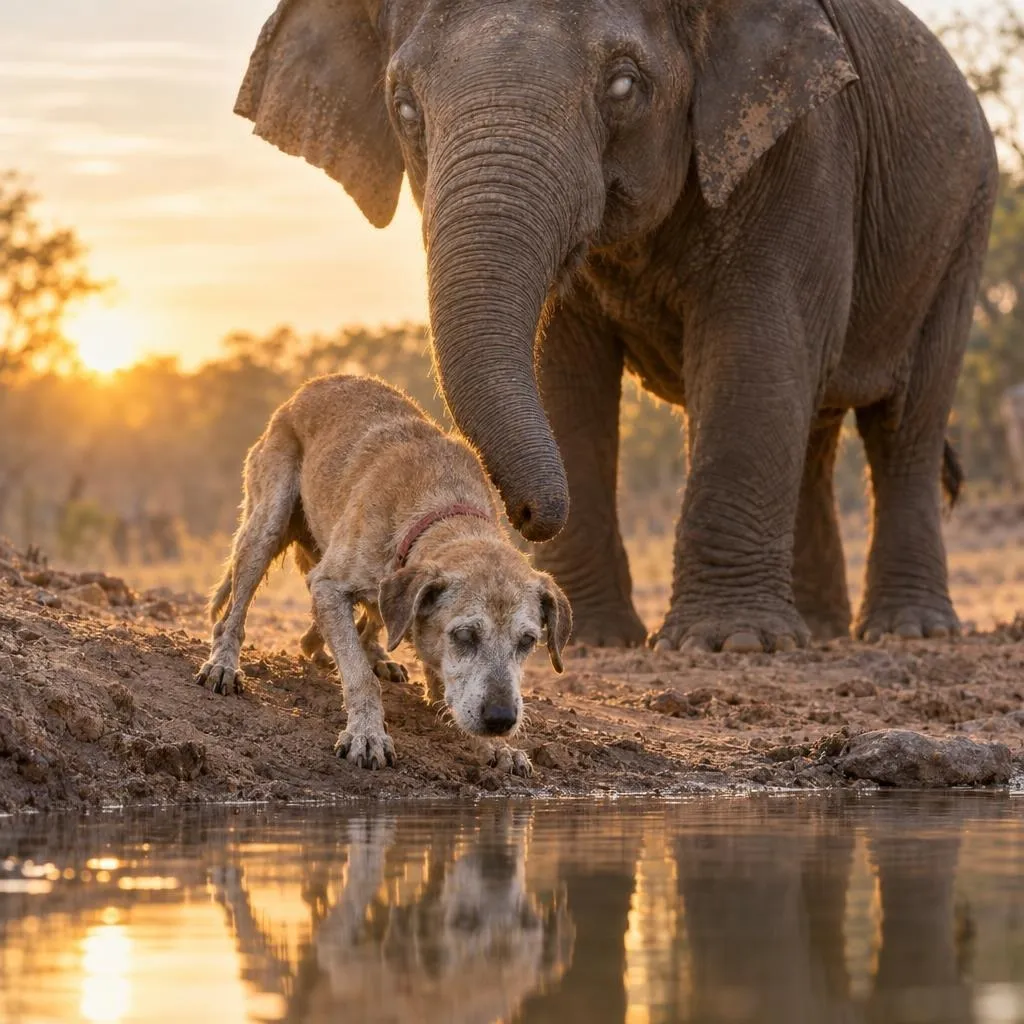
At the sanctuary, Amos heard us enter and turned toward the dog without trying to escape. By Wednesday, he was reaching before Finn had finished settling into the hay. His trunk came to rest below the scar on the Labrador’s shoulder. Finn exhaled through his nose, stirring a few dry stems.
Nora recorded the contact on the back of the feeding sheet. When she handed it over, I turned to the front first.
“He’s still losing,” I said.
“I know. But look at him.”
The calf stood quietly while Finn scratched an ear.
We agreed to offer the next morning’s bottle with the dog beside him. No new formula, no other changes. We needed to know whether this one difference mattered.
Luis arrived Thursday carrying the bottle upright in a feed bucket. Amos caught the smell immediately. His trunk lifted from Finn’s shoulder, and all four legs braced.
Luis stopped.
Finn got up. Whatever reluctance he’d brought to supper at the shelter didn’t apply to that bucket. He crossed the room and sat beneath it, his tail sweeping the floor.
“Sorry, fellow,” Luis whispered. “Not your breakfast.”
The tail kept moving. When nothing came down from above, Finn tipped his nose up and let out an impatient, high-pitched complaint.
A few feet behind him, Amos planted his forefeet and began lifting himself out of the hay…
To read the rest of the story – CLICK the NEXT button 👇👇👇